
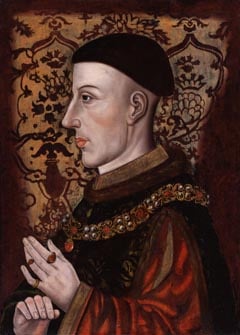
A book has been launched to mark 600 years since the coronation of one of Monmouth's most famous sons.
Henry of Monmouth was born on 16th September 1386 in the tower above Monmouth castle gates and crowned King Henry V on 9th April 1413.
David Harrison's book celebrating the life and times of the former monarch was launched in the Shire Hall's Henry V room last Wednesday (27th March).
Introduced by Richard Wills, Mr Harrison gave an entertaining and informative insight into the life of Henry V with his usual wit and aplomb, with references to, amongst others, Richard III, John of Gaunt, Henry's father and Owain Glyndwr.


Attended by the Lord Leuitenant for Monmouthshire, Simon Boyle, and the Mayor of Monmouth, Gerry Bright, the evening was rounded off with a toast to Henry V, a 'Star of England' and a second toast was proposed to the late historian Keith Kissack, to whom the book was dedicated.
The book is available from the Shire Hall, Monmouth Bookshop, Rossiters Bookshop, Stephens Bookshop and Ross Old Books.
Henry V was the son of Henry IV (Henry of Bolingbroke), and 17-year-old Mary De Bohun, an Essex heiress.
He was not their first child, two years previously Mary had given birth to Edward, who died almost immediately.
Mary and Henry of Bolingbroke lived at Monmouth Castle for the first years of their marriage. Mary may have continued to live here sporadically but Henry, following his father's fortunes, lived in many different places after 1388.
Young Henry of Monmouth was brought up in the area and presumably knew the landscape well, which helps to explain why he was so successful in battle along the Marches against the likes of Owain Glyndwr, the last native Welshman to hold the title 'Prince of Wales'.
Henry IV's reign was tumultuous. He did not inherit the throne directly but seized it from Richard II and there was much rebellion based on the belief that a king was legitimate only through succession (inheritance of the throne).
However, Henry IV managed to stave off these attacks, which amounted to minor wars at the time, because his son, Henry of Monmouth, was a brave and skilled soldier.
Henry V, once on the throne, set out to France and, in the famous Battle of Agincourt, defeated the French. However, a treaty was made, he married the king's daughter, Catherine of Valois, (his first wife, Mary, having died at the age of 24, giving birth to her seventh child in Peterborough castle).
In 1421, a son was born to King Henry of Monmouth and Catherine, who was to become the next king of England – Henry VI.
Henry of Monmouth's reign was surprisingly peaceful, possibly attributable to his early warlike reputation quashing opposition to his leadership.
One of Henry V's lasting policies, starting in August 1417, was his promotion of the use of the English language in government as well as the adoption of English as the language of record within Government rather than the use of French.
He was the first king to use English in his personal correspondence since the Norman conquest, 350 years earlier, thus putting an end to the 'Norman/ French' hold over the culture of the English aristocracy.
Ironically, Henry V died suddenly on 31st August 1422 near Paris, apparently from dysentery.
After the Treaty of Troyes, he was due to be given the French crown but did not live long enough.
Shortly before his death, Henry V named his brother John, Duke of Bedford, regent of France in the name of his son Henry VI, then only a few months old.
Comments
This article has no comments yet. Be the first to leave a comment.