

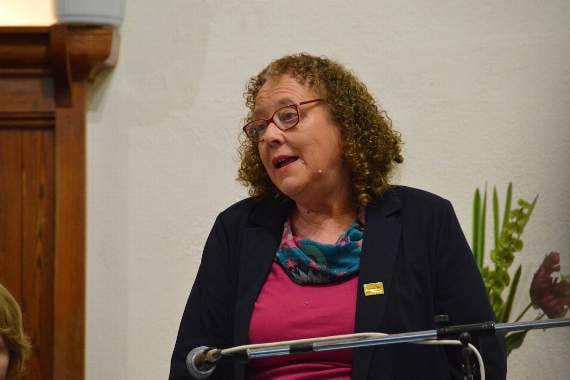
Election candidates were put through their paces in the first election hustings at Monmouth Baptist Church on Sunday (23rd November).
Chaired by the minister for the church Reverend Jonathan Greaves, all six candidates were asked questions on a number of topics from Brexit to social justice.
After an opening prayer, the candidates, lined up alphabetically, were given an opportunity to introduce themselves to the Monmouth electorate.
Ian Chandler, the Green Party’s candidate, opened by speaking on how Skenfrith was affected by the recent flooding. He argued that this needs to be an election on climate change and that his policies represent the interests of future generations.


David Davies, the Conservative Party’s candidate said that this election was a "Brexit election". He presented himself as a Brexiter, who wanted to honour the outcome of the referendum, adding that he wants a Conservative majority in parliament in order to get Boris Johnson’s deal through. He said he would never want to see the NHS get "sold off", would like to see more money go into education, more police officers on the streets and that he supports the UK becoming carbon neutral by 2050.
Independent candidate, Martyn Ford said that his Christian values inform his political philosophy. He strongly believes in the principle of free speech, he said.
Hugh Kocan, Plaid Cymru’s candidate, said he wants to see more autonomy for Wales so that "public policy can be designed for people living in Wales and not for people in London".
Yvonne Murphy, Labour’s candidate said she was standing because she grew up under a Conservative government, as are her children now. Her platform focused on the growing divide between rich and poor. She spoke about the growing number of people using food banks and problems of homelessness as a result of Conservative austerity policies.
Alison Willott, the Liberal Democrats’ candidate, presented herself as a passionate environmentalist. She said that the EU would be stronger for having the UK’s influence within it saying "we work better together". She presented the Liberal Democrats as a strong remain and environmentalist party.
Questions on Brexit were then put to the chair by members of the public.
Martyn Ford said that he was in favour of the UK withdrawing from the EU. "We can’t possibly ignore the results of the referendum," he said. He asserted the importance of voting for a candidate who would see Brexit implemented.
Hugh Kocan said that he was in favour of Brexit initially and that he was interested in the promises of becoming a country that can build its own identity and practices. He now fully supports remain and believes we will be better off in the EU.
Yvonne Murphy spoke of her respect for people who voted either way on the referendum. She said that the withdrawal process was part of a "Tory-driven agenda", with the party trying to sort out its own internal conflicts. She wants Labour to renegotiated a new deal and put it to the people in a confirmatory referendum.
Alison Willott said that if the Liberal Democrat were to gain an absolute majority in parliament, they would consider that a democratic call to revoke Article 50. Short of that, she said, the Liberal Democrats would support a second referendum on Brexit.
Ian Chandler agreed with the idea of a people’s vote, but disagreed with the revoking Article 50 without a people’s vote saying it would be an "insult to voters".
Yvonne Murphy was asked to clear up the uncertainty of the opinions of her party leader, Jeremy Corbyn. She said that the only way to get a good deal with the European Union, was for the leader of the party to stay neutral and added that Labour Party candidates were under no obligation to follow suit. The deal that Labour would aim for, she said, would be one that would have a close alliance with the customs union, a close alliance with the single market, retain workers’ rights, consumers rights and environmental protections; with a people’s vote to decide the final outcome.
On the topic of animal rights after Brexit, Martyn Ford said that he wants an end to factory farming in this country and in the whole of Europe. He added the best way to do this would be to subsidise other forms of farming and to ban the import and export of live animals.
Ian Chandler argued the point that a Conservative Brexit would not ’get Brexit done’ but rather only be the beginning of further negotiations that would "carry on for years to come".
During a question about the remain alliance and tactical voting, Hugh Kocan said that not all ’leave’ voters or ’remain’ voters think the same way and having a spread of different political viewpoints is worthwhile. He added that he would like to see a fairer voting system.
Yvonne Murphy agreed that the current voting system isn’t fair and, if elected, would campaign for proportional representation.
Alison Willot said that behind the scenes parties do work together and that the problem comes from the debating chamber.
She said that the distance between the House of Commons benches was determined by how far someone could swing a sword and not hit a person on the opposing bench was a example to how the debating chamber is a place that fosters conflict. She said she’d prefer the house-shoe shaped chamber of the Welsh assembly which encourages more constructive dialogue.
Ian Chandler spoke about the benefits that might come from having more powers devolved to local areas, where people can have more direct control over policy decisions that affect their lives.
David Davies said that while nationally there are "idiots from all parties", campaigns in Monmouth are largely without problems in regards to civility.
Martyn Ford he would like to see more parties and independents in the chamber and that more ideas in the House of Commons would make it a more civilised place.
When the panel was asked about how they would fund their policies, Yvonne Murphy said that raising taxes on those earning more than £80,000 is Labour’s plan. David Davies responded by saying that raising taxes too highly on top earners could cause them to leave the UK.
Alison Willot argued her party’s policy of adding a penny onto income tax to focus on healthcare, specifically mental heath.
David Davies defended the cuts to public spending and that his party did their best to not make those cuts hurt.
Martyn Ford said that borrowing for public spending was putting an obligation on future generations that they didn’t ask for.
During a follow up questions on spending, David Davies said that the funding of local authorities is done through the Welsh Assembly’s policies, which are biased against rural areas. He said that Monmouthshire has received a cut in funding, where as various Labour-run local authorities received an increase.
Poverty was also a issue that was raised. Ian Chandler said that when we end up having to pay benefits to people as a result of low wages, we’re not subsiding people, but subsidising corporations.
David Davies said that there is a shortage of housing and that people from all parties need to be "a bit more supportive of applications for new housing developments".
Future hustings are set to take place. There will be two today (27th November) at Monmouthshire Market in Raglan at 3.30pm and another at the Abergavenny Community Centre at 7.30pm. There will then be a climate emergency hustings on 29th November at Bridges Centre, Monmouth (7pm) before a hustings at Chepstow School on 4th December.
Comments
This article has no comments yet. Be the first to leave a comment.