

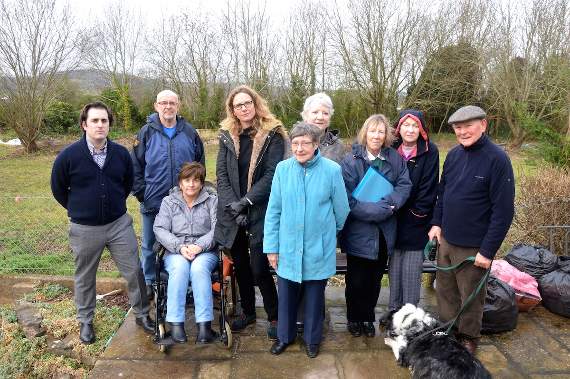
WYESHAM residents have voiced their concerns about a planning development on ‘contaminated’ land, brought to light in last week’s Beacon (3rd February).
Plans for a development of 11 houses and a new vicarage in the area were first raised in 2012. After the application appeared to disappear, it has resurfaced after an Instrusive Ground Investigation Report was written and published at the end of last year.
The application, which proved unpopular when it emerged in 2012, has come under fire from residents who are against the development citing it as “insane” and stating that it would have “serious implications” for the area.
The original application requested permission to demolish the vicarage at Wyesham and build nine houses on the former Welsh Water site. Now, new plans have surfaced that, if approved, would see 11 houses and a new vicarage built on the site.


Trial pits were dug in 2015 and the soil was sampled for contamination after the presence of asbestos came to light from anecdotal evidence.
The former reservoir was used as a ‘dumping ground’ according to local residents, with the site being used to discard industrial waste including lorry tyres, industrial waste and sawdust as late as 1994. There is also anecdotal evidence from residents that the site was used as a dumping ground for asbestos pre-fab buildings that were demolished in the 1960s.
Out of the 16 samples taken from the survey, two recorded the presence of asbestos, with ‘cobble sized’ asbestos sheet fragments being discovered.
The report concluded that remaining contaminant levels are not considered to represent high levels of contamination and although would be suitable for retention in a commercial land use, would not be suitable “for retention in the upper 600mm of garden areas of a residential site”.
Despite the report, residents are concerned about what they see as a lack of thorough testing of the site.
A letter from Paul White, Head of Environmental Health at Monmouthshire County Council (MCC) to Phil Thomas, Planning Officer for MCC suggested that more tests should be taken in the area, recommending in a letter uploaded to MCC’s website last Thursday (4th February) that: "the developer provides further justification for the sampling frequency undertaken."
"It appears the majority of contamination (including all identified asbestos) is limited to the south western part of the site, as a result of the infilling of the filter beds, reservoir and water tank,” he continues.
“However as the site appears to have had some un-licensed/ un-recorded uses and potentially some refuse disposal; and because made ground has been found across the majority of the site, together with asbestos containing materials and loose asbestos fibres, I would recommend that additional sampling and asbestos screening be undertaken, as well as the delineation sampling mentioned above.”
Labour AM candidate Catherine Fookes also expressed her concern about the plans, stating that the site wasn’t the “right place” for new housing.
“I am very keen on new affordable housing in appropriate places, as there is a housing waiting list in the constituency of over 3,000 which desperately needs resolving. However a contaminated site isn’t the right place for housing,” she said.
In addition to concern about the presence of asbestos, there are also worries about landslides in the area, an increase in traffic flow and the conservation of bats, dormice and great crested newts in the area.
National Resources Wales (NRW) published a letter to MCC’s Planning Portal on Monday (8th February) objecting to the application until the plans were revised. In this, they advised “an updated bat survey report of the old vicarage”, a report on bat activity in the trees surrounding the site and an assessment of the use of the site by dormice and great- crested newts.
There is also evidence of invasive plant species Japanese knotweed on the land.
The amended plan will be assessed by MCC’s planning committee in the future.
Comments
This article has no comments yet. Be the first to leave a comment.