
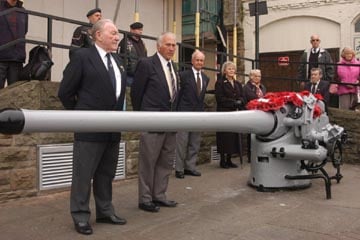
It is an occasion largely forgotten across Wales, but ANZAC day was remembered at a small service in Chepstow last Wednesday (24th April).
Chepstow Town Council is thought to be the last remaining Welsh council to officially commemorate the Australian and New Zealand Army Corps' involvement in all wars, and does so because of the town's proud links with one heroic seaman.
At 11am on 24th April, many gathered to hear the tale of a son of Chepstow who nobly gave his life for his country 98 years ago, and was recognised by King George V alongside five others, with the Victoria Cross.
Born in Shropshire and raised in Chepstow, William Charles Williams joined the Navy in Portsmouth in 1895 and made the rank of Able Seaman in 1901. Throughout his career Able Seaman Williams served on 18 ships.


After returning to civilian life in Wales in 1910, Williams worked with the Newport police force and steelworks before being recalled to service at the start of the First World War.
Aboard HMS River Clyde, Williams served in an attack on the Turkish peninsular of Gallipoli in 1915, a battle that would see the Chepstow man fatally wounded.
The plan was for the River Clyde, along with a number of transport barges – between them carrying 2,000 soldiers – to come alongside another ship that had been beached, to form a jetty from which the soldiers could disembark. From here they would seize the heights of the peninsular overlooking the beaches.
But it went wrong. The first ship had failed to reach the shore, and as the men attempted approach the beach, heavy enemy machine-gun fire began to rake the shore.
The first two companies of soldiers that emerged from the Naval troops were hit hard and suffered 70 per cent casualties. So in an attempt to reach the shore, the Captain of the River Clyde led Williams and others outside to manhandle three barges to form a bridge to the beach.
Able Seaman Williams stood chest-deep in the sea, holding two barges together with rope, allowing two battalions of soldiers to reach the beach.
This is why today, as you visit Williams' memorial on Chepstow High Street, you will see detail of two pieces of rope on the ground where you stand, representing the hero's strength in keeping the barges together.
Able Seaman Williams was seriously injured in the process and later killed in a shell explotion, aged 34.
The register of Victoria Cross holders states: "[he was] later killed by a shell whilst his rescue was being effected by his commander, who described him as the bravest sailor he had ever met".
After the War, the captain of HMS River Clyde, Captain Edward Unwin, was asked to come to Chepstow to reveal a commemorative painting of the battle that hangs in St Mary's Church to this day.
In replying to the invitation, Captain Unwin, who was also awarded the Victoria Cross, said: "I shall be very happy to unveil the memorial at Chepstow. Williams was the man above all others who deserved the Victoria Cross at the landing. He died in my arms."
This letter and more artifacts can be found in a special display about William Williams in Chepstow Museum.
The display also contains a bronze medallion created by an anonymous Liverpool shipowner, awarded to all who received Victoria Crosses that day. It states: "In proud memory of the great deeds performed by a Liverpool ship". Williams never married, and the medallion was awarded to his sister, Frances Smith.
A replica of Williams' Victoria Cross also hangs in the museum, despite efforts in recent years to purchase the treasured item as it came up for sale.
The museum attempted to buy the medal with the use of a Heritage Lottery grant of £50,000, but was eventually out-bid by Lord Michael Ashcroft, who has since loaned the medal for it to be displayed in London's Imperial War Museum.
Williams' Victoria Cross was awarded to his father W Williams and his stepmother at Buckingham palace in 1916.
After the War had ended, King George V also presented the town of Chepstow with the 105mm gun from the surrendered German submarine UB91, to commemorate the actions of their heroic naval son at Gallipoli.
Present at Wednesday's service, held at the gun, were several members of the Royal Naval Association, SSAFA and other charitable organisations, town council members, and three members of Williams' family.
The seaman's neice Carol Dutson, and great neices Sharon Putwain and Sandra Boshein attended the event. Sandra said: "I've grown up with coming here every year and I'm very proud to do it."
Also present were David Richards and Ian McLauchlan, both members of Chestow's Royal British Legion.
All at the service, led by Reverend Webster, prayed for Australian and New Zealand troops, including the 250,000 Australian, New Zealand, French and Englishmen killed at Gallipoli.
Speaking to the crowd, Commander Christopher Wilson, president of the Royal Naval Association, said: "Able Seaman Williams demonstrated his totally unselfish commitment to those soldiers for whom he was responsible.
"We would all do well to follow the example of that Chepstow man William Williams, and try to think always of how we may help others".
Comments
This article has no comments yet. Be the first to leave a comment.