

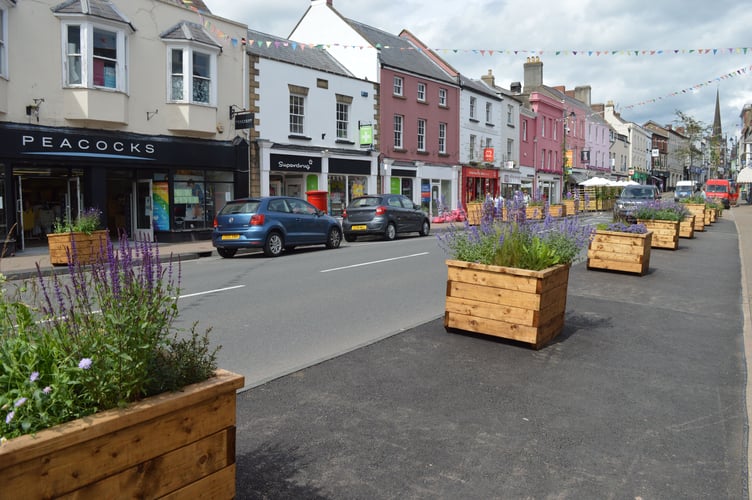
For several months, the Chamber of Commerce has been reporting the response of many high street traders and its overall membership, to the proposed changes to Monnow Street.
It is, therefore, important to address David Hoyle’s assertion that ‘the Chamber of Commerce present no facts proving that street layout has directly caused economic decline to Monnow Street’.
The facts are, as we have frequently emphasised, that shopkeepers can determine whether their turnover is down and can monitor the drop in footfall from their business premises.
They after all are living with this day in, day out.




They have also been listening to complaints for a long time from customers that the restrictions on parking have created hardships in accessing convenience stores, chemists and opticians.
Since the measures to safeguard against the pandemic were implemented, some local residents have decided not to shop in Monmouth and say they now take their custom to Ross, Coleford or Abergavenny.
Boots the Opticians and Blue Cross Charity closed their shops because custom had fallen below a sustainable level.
MCC’s objective to encourage visitors by cycling and walking ignores the obvious; visitors from further afield will use a car to reach Monmouth or perhaps arrive by coach.
And a significant number of people visiting the town regularly, live in outlying areas and cannot walk or cycle the distances involved. Even if they could, it is unlikely that they would be able to carry a week’s food shopping.
David Hoyle is fortunate in living on the Redbrook Road, so walking into town is eminently practical for him.
Interestingly, a high proportion of correspondents to the Beacon who are proponents of the scheme, also live within a walking or cycling radius of the high street.
The Chamber is not just defending the interests of the business community but is also the recipient of emails and visits from elderly and less mobile residents who are fearful that the planners’ proposals will impact greatly on their ability to access Monnow Street.
These are people who come to the Chamber rather than to their councillors because we are not only stating the view they hold but also because they feel we are the only group listening to their concerns.
It is disingenuous to suggest the Chamber ‘wants to turn back the clock’.
Commerce, in all forms, is obliged to be forward-looking, trying to anticipate market changes and working towards more environment-friendly practices.
It also has to be viable, and when seeking to find evidence that MCC’s objectives will improve footfall and benefit trade, no assurance would seem to be available.
What the Chamber wants is what is best for town businesses.
Your other correspondent, David Farnsworth, agrees that the Council has no evidence that their scheme will make Monnow Street ‘more vibrant’, and appears to support the suggestion by the Chair of the Chamber that the more measurable experiment would be to postpone radical changes and revert to the pre-Covid status.
He also rightly points to the value of heralding heritage and character in creating destination places; the bi-product of this is that visitors who feel satisfied with their experience also put money into the local economy.
It is a huge gamble to destroy layers of history - one of the main reasons Monmouth has been a tourist destination for 250 years – and replace it with a planners’ stock catalogue of trees, rain gardens, cycle parks and outdoor eating areas.
Finally, both Davids recommend more frequent markets, carnivals, festivals and year-round events, but without suggesting how these might be funded and who would organise them.
Invariably, the latter falls to volunteers and the former to public resources or patronage from the business community.
Monmouth Festival has struggled to continue due to lack of financial support and, increasingly, less people are coming forward to volunteer for the hard work and commitment of organising events.
Throw in loads of form-filling and the obstacle of red tape and whilst this would be lovely for our town, it is easy to see how unlikely is the expansion of an entertainments programme.
The Chamber of Commerce fully understands the need for change but its members, many of whom are independents or sole traders, cannot risk an enormous, costly, irreversible scheme based on whimsical suppositions rather than hard, gilt-edged facts.
David Evans
Secretary,
Monmouth Chamber of Commerce
Comments
This article has no comments yet. Be the first to leave a comment.