
The water vole is Britain's fastest declining mammal, due in a large part to the creature finding it hard to maintain its native position in our waterways because it is the meal of choice for a foreign interloper, the American mink.
American mink were introduced to the UK in the early 20th century to be farmed for their fur.
Subsequent escapees, whole farms full being released by animal rights activists and possibly also farmers faced with enforced closure in the 1970s, releasing their stock into the wild, have meant that the UK ended up full of the non-native predators.
Where water voles are present, mink feast on them for up to 85 per cent of their diet. And once the local water vole population is eaten up, the mink move onto other river dwelling species, including fish, king fishers, moorhens and ducklings, having a devastating effect on the traditional ecosystems of our rivers.
.png?width=209&height=140&crop=209:145,smart&quality=75)



Until very recently nothing much has been done to control this invasive pest, but, after a successful pilot scheme on the river Dore in Herefordshire, which proved that mink could be eradicated from large stretches of the river and water voles reintroduced, the Monnow was the next river in the UK to benefit from a mink eradication project.
Rob Denny, project officer for Monnow Rivers Association (MRA) is in charge of overseeing the project. "I became interested in this project because, as a fisherman, I believe in putting back more than you take out," he said.
"This is a project that really benefits the local ecosystem and, since it has been proven possible to eradicate mink effectively, there is no reason why we would not do this for our wterways."
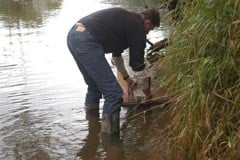
Rob co-ordinates the river watches; a number of floating platforms along the river which house a small tray of clay. The mink (or any other creatures for that matter) walk over the clay, leaving their tracks, thus alerting the conservationists to the presence of mink.
Once mink tracks have been detected, humane traps are laid to catch the mink, which are then humanely destroyed.
Once the mink have been eradicated water voles can be reintroduced successfully, and, as long as the mink population is continuously monitored and controlled, the re-establishment of a more traditional river ecosystem is possible.
"There is very little investigation into the correlation between mink prevalence and otter population, but, in my experience, otters move out when mink move in.
"Just today we found otter tracks on a stretch of the river Monnow where otters have not been seen in a very long time. I am assuming this is because of a recent eradication of mink on this particular stretch of river."
The other problem for the riverbank and for water voles, is the invasion of Himalayan Balsam, which takes over riverbanks, eliminating native species and leaving the water voles with nothing to eat.
This plant is also perennial so from October it dies back, leaving the riverbank, and water voles exposed. The Monnow Rivers Association works hard with other community groups to pull up and clear the riverbanks of this weed.
The MRA is always in need of volunteers to help monitor river rafts and manage the riverbanks. If you are interested in helping out or would like to know more email Robert Denny on [email protected]">[email protected]
Comments
This article has no comments yet. Be the first to leave a comment.