
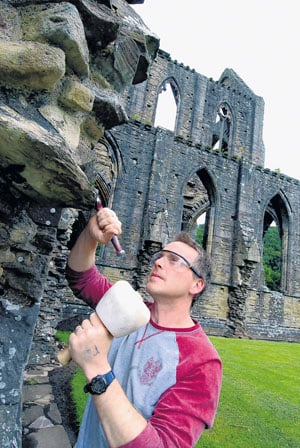
Stonemasonry Apprentice, Huw Thomas (40), is currently showing his skills, working on the restoration of the Wye Valley's oldest building, Tintern Abbey. Experts say Wales traditional building stock, including historic buildings, are in danger of falling into disrepair as the current shortage of a skilled and qualified workforce is putting the conservation, restoration, repair and maintenance of these buildings in jeopardy. The skills gap is particularly pronounced in stonemasonry. Apprentice Huw Thomas has just completed the first year of a two-year stonemasonry apprenticeship at City of Bath College. He is completing his apprenticeship with Cadw, the Welsh Assembly Government's historic environment service, which aims to assist the conservation and appreciation of the Welsh historic environment. Huw is currently working on the restoration of Tintern Abbey. He selected the stone masonry course because he wanted a change from his previous office-based career and believed stonemasonry would be much more interesting. Huw told The Beacon "The stone masonry apprenticeship appealed to me because it was an area that was open to all ages. "There are 18 people on my course, the majority of which are around 17 or 18; however, the people who are already in the sector are usually about 50 years old. I'm really enjoying the course and am considering whether to extend the length of my course to allow me management opportunities as well. "I particularly like seeing the final product completed as the whole process is long and detailed. Stonemasonry really is more than meets the eye". Attracting people like Huw, with the potential to become accomplished traditional craftspeople is a key target for ConstructionSkills, as is making improvements in the amount of quality traditional building skills training there is available. ConstructionSkills is committed to ensuring that these skills, and more specialist trades, donít die out. The stonemasonry craft is a sustainable, well paid career option and the care and maintenance of Wales buildings requires the right skills, in the right place, at the right time to maintain Wales heritage. The 'Traditional Building Craft Skills: Assessing the Need, Meeting the Challenge' report is the first ever skills needs analysis of the traditional building sector in Wales. The report was jointly funded by ConstructionSkills, the Sector Skills Council (SCC) for construction, which is working towards delivering a safer, more professional and fully qualified construction workforce, and Cadw, the Welsh Assembly Government's historic environment service . The report was launched at the NHTG's first national conference and will be showcased at the Royal Welsh Agricultural Show, where Jane Davidson, Welsh Assembly Government Minister for Sustainability and Rural Development, helped to highlight the findings of the report at the Cadw Historic Wales stand. The 'Traditional Building Craft Skills' report highlights the need for immediate action and found that: If all repair, maintenance, conservation and restoration work on pre-1919 buildings was undertaken using the required traditional building craft skills and materials the sector would constitute four per cent of the total construction output for Wales worth £122million. At current levels it constitutes 1.6% with an estimated value of £48 million. In order to meet the current demand and to provide the level of skills and resources required in the future, around 500 additional workers are needed, primarily within stonemasonry, carpentry, roofing (slate and tile) and plastering over the next four years. Experts fear that in 15-20 years time, the skills essential to repair, maintain, conserve and restore the pre-1919 building stock will be seriously threatened without immediate, coordinated action to provide specialist, targeted training for a range of traditional building craft skills. The report has found that industry culture, trade practice and the historic lack of awareness among most building owners can lead to the use of inappropriate methods and materials on pre-1919 buildings. The report also shows that a growing demand for heritage skills training is demonstrated by the number of short courses being provided by independent organisations and material manufacturers and suppliers, yet there is practically no take-up of existing heritage skills modules offered on an optional basis by FE colleges. This is due to the content on construction courses being driven entirely by the new-build sector of the construction industry to the detriment of the traditional building skills sector. This can be reversed by courses teaching the difference in construction and repair and maintenance of old buildings from modern buildings.


