

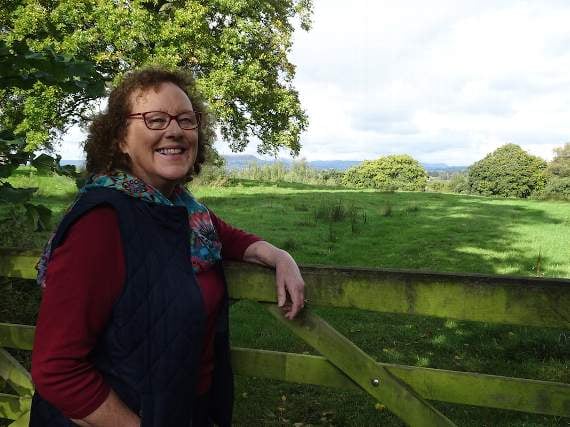
MONMOUTHSHIRE will go to the polls on 12th December after a General Election was called by Prime Minister Boris Johnson.
Ahead of the election, the Beacon asked all Monmouth candidates a set of questions.
Who are you?
I’ve lived near Raglan for 25 years. I read classics at Durham university and was a senior civil servant in the Foreign Office and Department of the Environment. I was a CAB cebt adviser in Abergavenny, a Gwent magistrate, and a caseworker in Cardiff. I am on my local parochial council. I’m also a trustee for the Gwent Wildlife Trust, and do all I can to encourage biodiversity. We garden organically, with veg, fruit and hens, and have planted 6,500 native trees on our field to combat flooding and mop up carbon.


Why should people vote for you on 12th December?
They will get an MP who is local, and fully committed to serving this area and the people living here. My party will fight to stay part of Europe, and will tackle climate change; we will put extra money into social care and mental health; and I will work to help our local communities and businesses.
The tactical vote consideration: Liberal Democrats are the only party that can beat David Davies here. The Conservatives had a majority of 4,000 last election over all the other parties added together. To defeat Davies we need many Tory voters to switch their votes. Many moderate Conservatives distrust Boris and want remain. They are furious that their party has dumped people like Ken Clarke and Philip Hammond. They will vote Lib Dem. They will never vote for Corbyn, with his fiscally irresponsible manifesto. If everyone from all the opposing parties were to vote Lib Dem, we have a sporting chance of defeating David Davies. Labour can’t do it: their support is less than it was in 2017 and they won’t get the switch votes from Conservatives.
What should we be doing to deal with climate change?
This is a top priority for the Lib Dems. Some of our policies: we would put green living at the heart of government, with a Sustainability Treasury Secretary having a Cabinet seat. Set targets for Departments and local councils. Restore subsidies for renewable energy, setting a target of 80 per cent renewables by 2030 and 100 per cent by 2045. All new houses would have to be zero-carbon and we would ensure that all our housing stock would be insulated to modern standards by 2030.
Transport: switch to electric vehicles (including a network of charging points), electrify the railway. Put £4.5 billion into buses and fund councils properly to provide much better services. Prioritise cycling and walking. Tax frequent flyers and stop Heathrow’s third runway.
Ban single-use plastics in three years. Give consumers a right of repair, so that everything you buy can be repaired, rather than having to be thrown away.
Put £18 billion into tackling biodiversity loss, restoring hay meadows, peatlands, wetlands etc. Plant 600 million trees to mop up carbon and help to prevent flooding.
How do you think Brexit will affect the day-to-day lives of people in the constituency?
I think Johnson will fail to complete a trade deal by the end of 2020, so it is likely that we will leave with no deal. The damage to Wales will be immense; 80 per cent of meat and fish exports go to Europe. Overnight, farmers will lose their markets. Airbus may pull out altogether. Investment by European firms will dry up. We will lose European staff from our universities, research departments, the construction industry and the health and social care sector. Welsh ports currently add a lot to Welsh GDP; this may dry up. In short, the effects on Wales will be catastrophic. The Monmouthshire economy has a large base in agriculture, and a lot of spin-off jobs will be affected, while money coming from Cardiff into the county will drop substantially.
What do you think is the biggest challenge facing the next MP for Monmouth?
Dealing with Brexit. Our local MP needs to fight strongly to keep us in the EU.
Climate change must be tackled at all levels, from the smallest village, through the towns and over the whole county, involving everyone.
A subsidiary issue is the question of drugs: a massive problem affecting our young people. As MP, I would work to get all sectors meeting together to work on a solution: including small and large councils; residents’ associations; schools; police; youth workers. Young people’s voices are especially important – let’s set up Youth Assemblies to talk about this difficult problem, which must be tackled head-on.
Comments
This article has no comments yet. Be the first to leave a comment.