
And this weekend, thousands will take part in services around the county to remember those killed in the two world wars, and in conflicts around the world since.
The naval service, which takes place each year, remembers the lives lost of around 1,500 crew, including Admiral Sir Christopher Craddock, when the British Navy ship came under fire from heavily armed German ships at the Battle of Coronel off the coast of Chile.
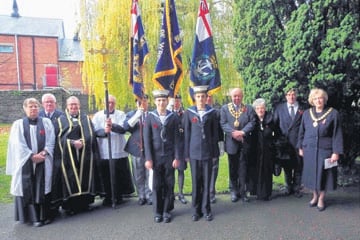
Rev David McGladdery conducted the service, saying: "Let us remember before God and commend to His sure keeping those who have died for their country in war, those whom we knew and whose memory we treasure".


The special service is organised each year by the Monmouth branch of the Royal Naval Association (RNA) and Monmouth Sea Cadets James Phillips and Thomas Lynch-Warden, both 13, were present at the memorial to lay wreaths.
A tribute to the fallen crew is present in St Mary's Church in the form of an oak and glass panel screen topped with the crest of the current HMS Monmouth. Also in place in the church is the Honour Roll of the fallen men. The book states:
"The Secretary of the Admiralty regrets to state that, according to the latest information available, the falling Officers, Petty Officers, Non Commissioned Officers and men were serving on HMS Monmouth at the time of recent action.
"In absence of evidence to the contrary it is feared that they must be reasonably assumed as having lost their lives".
A memorial to those who died in the Battle of Coronel can be found in the 21st May Plaza in Coronel. Erected in 1989, the plaque reads: "In memory of the 1418 officers and sailors of the British military squadron and their Commander-in-Chief, Rear Admiral Sir Christopher Craddock, who sacrificed their lives in the Naval Battle of Coronel.
Their only tomb is the sea."
Mayor Gerry Bright, who attended the service, said: "It is extremely important that we, the benefactors of such extreme sacrifice show our deepest respect to those forces of yesteryear and show support for those who in conflict since then.
"The forces that to this present day are prepared to sacrifice all for the peace we enjoy in our daily lives.
"Let the lessons of yesteryear guide those who rule to be strong in our defence and lead us away from total war, for next time there will be no winner, only losers, on a scale that none of us can imagine."
The sinking of HMS Monmouth was reported on in the Monmouthshire Beacon in 1914.
The article, printed on 6th November states: "The Admiralty have now received trust-worthy information about the action on the Chilean coast.
"During Sunday, November 1st, the Good Hope, Monmouth and Glasgow came up with the Scharhorst, Gneisenau, Leipzig and Dresden. Both squadrons were steaming south in a strong wind and considerable sea. The German squadron declined action until sunset, when the light gave it an important advantage.
"The action lasted an hour. Early in the action both the Good Hope and the Monmouth took fire, but fought on until nearly dark, when a serious explosion occurred on the Good Hope and she foundered.
"The Monmouth hauled off at dark, making water badly, and appeared unable to steam away."
The ship was sunk at 9.18pm.
Comments
This article has no comments yet. Be the first to leave a comment.