
DESPITE the grey day and persistent rain, a group gathered around Chepstow's war memorial last Friday (25th April) to commemorate Anzac and in particular, the memory of Chepstow soldier and Victoria Cross recipient William Charles Williams. Now in its 99th year anniversary, the memorial day, known on antipodean shores as Anzac day, is held in memory of the Australian and New Zealand Army Corps' involvement in all wars and in particular, the anniversary of the 1915 dawn landing in Gallipoli. For those in Chepstow, it is particularly relevant for Chepstow raised Williams, who died whilst fighting gallantly exactly 99 years ago last Friday. Williams, who was 34 at the time of his death, joined the Royal Navy Boys Service in Portsmouth in 1895. He was promoted to Boy First Class 1896, Seaman in 1898 and Able Seaman in 1901, serving on 18 different ships during his Naval career. In 1910 he returned to civilian life to work within the police force and at the Newport steel works; however in 1914 he was recalled to serve in the Great War. On that fateful day, 25th April 1915, Williams was part of a major landing on the Gallipoli peninsula by the Allied forces, an operation that remains one of the bloodiest and most disastrous in recent military history. The Gallopili landings on the western shore of the Dardanelles were initiated in an attempt by The Allied Forces to knock Turkey out of the war and link up with Russia, who were threatened by the Turks in the Caucasus. Williams was serving in HMS River Clyde that, together with a number of transport barges towed behind, carried 2,000 soldiers. The plan was to come alongside another ship that would have already breached, to form a jetty along which the soldier could disembark to the beach. On the ill-fated attempt, heavy gunfire on the boats from the beaches began. Under intense machine gun and shell fire, Williams stood alongside the commander of the HMS River Clyde, chest-deep in the sea, holding a rope to stop the barges form drifting apart, aiding two battalions of soldiers to disembark. The official entry in the Register of Victoria Cross states: "Williams was eventually dangerously wounded and later killed by a shell whilst his rescue was being effected by his commander who described him as the bravest sailor he had met." The River Clyde suffered 70 per cent casualties. 250,000 Australian, New Zealand, French and British troops were killed over the duration of the Gallipoli battle. At the First World Wars conclusion,a German U-boat surrendered to the Royal Navy, with its 105mm Gun presented to the town of Chepstow by King George V in recognition of William's bravery. Also at the service were four representatives from the Chepstow Coast Guard, as well as members of the SSFWA and other charitable organisations and Chepstow's mayor and deputy. Commander Christopher Wilson, president of the Royal Naval Association, said: "It's important to remember. It's important that people are reminded that someone who is quite normal, can, when the chips are down, achieve something quite extraordinary. That within us all, we have an energy that may be brought out with a trauma or hardship. Williams was just that; he came from a very ordinary background who showed immense bravery and did something extraordinary."
Lest we forget
Tuesday 29th April 2014 11:00 pm
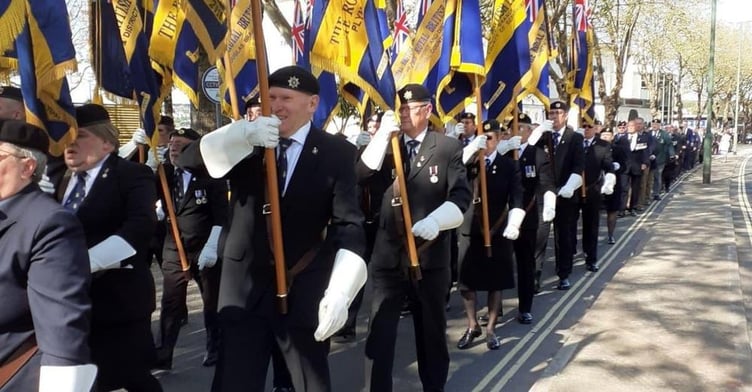
A Remembrance parade in Totnes


Comments
This article has no comments yet. Be the first to leave a comment.