
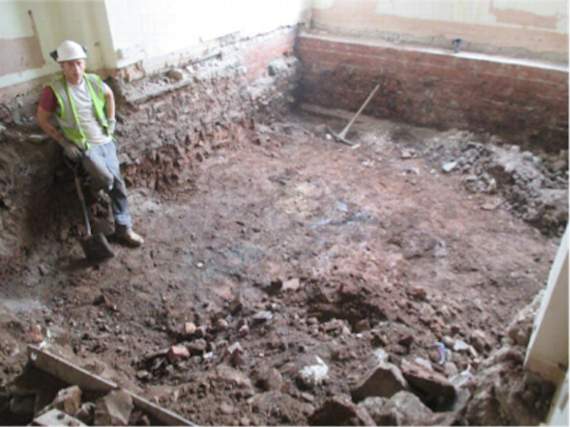
CURRENT building development at Commerce House has rung alarm bells with archaeologist Steve Clarke who has asked Monmouthshire County Council (MCC) to step in and mitigate on “an unfolding archaeological disaster”.
It was feared ongoing excavation work would be disturbing the ancient floor levels of this part of Monnow Street dating back to 13th Century, before an opportunity had been made to catalogue and preserve the existence of medieval life in that part of town.
As chairman of Monmouth Archaeological Society, Mr Clarke has provided a watching brief over many of the excavations and alterations in and around the town over the years; the group recently revealed the existence of an ancient fortified building on the new Rockfield estate.
The historian was sure that the rest of the building had a late 13th/ early 14th century medieval house floor with a central hearth. “The thick layer of brown silt under the wall was left by horrendous floods when Monnow Street was abandoned and the houses, which were often of wood, collapsed into the flood waters.”


After crisis talks with MCC, Steve was allowed access to the building yesterday morning (Tuesday 11th August) and uncovered the best example of a stone hearth found in Monmouth, dating back to the Black Death in 1348.
“We can date that period quite accurately,” he explained “by the absence of any pottery and remains in the years following the plague, as all the occupation stopped; there was no rubbish.
“We have the right pottery for the era and have the flooding silt layers as there was a lot of rain around that time and this is undisturbed flood silt.
“We thought that this hearth had gone with the excavations, but we were lucky as they had not gone down that far - the floor is intact.
“To think the occupants would have been sat around this hearth as the Black Death arrived!
“This is our only record of their lives at that time. I could see by the flood levels in the builders’ excavations that they had not gone down that far so it was important to get in and record the find as Monnow Street stopped growing at the time of the plague.”
It was in the 14th century flood silts just behind Commerce House, that parts of a unique jug in the form of a stylish medieval lady were found during building work in September 1987. This jug was made in a pottery kiln in Drybridge Park and displays a woman, attired in the fashion recorded in the Luttrell Psalter in 1343 – just five years before the arrival of the Black Death in 1348, pictured below.
She is wearing a penanular brooch and carrying a small pot and has various items hanging from her belt, including a key and a purse like that worn by the woman in the Luttrell Psalter. Earlier medieval remains and Roman pottery was also found there.
Once this has been recorded, policy is to cover it back up with a protective screed.
MCC Chief Executive Paul Matthews said: “I became aware of the findings at Commerce House the morning of Monday 10th August, and colleagues were sent to the site straight away.
“I’ve had a good conversation with Stephen Clarke. We share a desire to conserve and showcase the remarkable history that continues to be uncovered in and around Monmouth. We are doing what we can to create the time for Monmouth Archaeological Society to record and catalogue issues of historical importance on this site and I hope the developer will be supportive in this. Going forward I am keen to strengthen the links between the council and the archaeological society and will be meeting with Mr Clarke over the next few days to discuss how we can best do this”
The planning application, DC/ 2015/ 00134, requested a change of use from commercial to retail use with internal amendments including reducing floor levels of part of the building and revising the stair layout to ‘make the property more desirable for lease or sale’.
The plans were passed by MCC’s development control manager, Phillip Thomas in February of this year.
Cooke Arkright are currently advertising the premises as offering: “an open ground floor retail area over two levels with further retail space or ancillary storage to the first floor.
“The works will provide a new shop frontage with large display windows to both side elevations.”
Comments
This article has no comments yet. Be the first to leave a comment.