
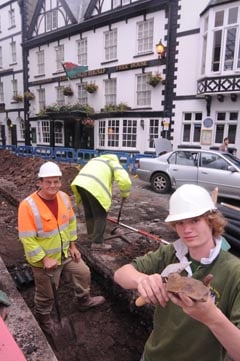
Monmouth archaeologists have been monitoring the excavations for the electrical services to the Shire Hall as part Monmouthshire County Council's refurbishment of the building, with some interesting results.


The trench at the junction of Agincourt Street with the Square reached a medieval road (beneath later roads) at less than a metre below the tarmac and this lay over a layer containing Norman pottery of the late 11th and early 12th centuries.
Beneath this, a somewhat sterile layer merged into the age of Monmouth's Roman town which was called Blestium in the third century.
However, the most exciting discovery was that the site was proved to be inside the Roman Fort, which is thought to have been established shortly after AD 50, making it a quarter of a century older that the Roman Fortress of Caerleon.
Monmouth Archaeological Society Chairman Stephen Clarke, told the Beacon: "An assemblage of pottery, including decorated Samian ware from Gaul and the base of an amphora thought to be Spanish constitutes some of the earliest Roman pottery from Wales.
"The excavations in Agincourt Street and Agincourt Square are being voluntarily covered by the Society while inside the hoardings the professional wing of the society are the council's archaeological contractors."
Comments
This article has no comments yet. Be the first to leave a comment.