
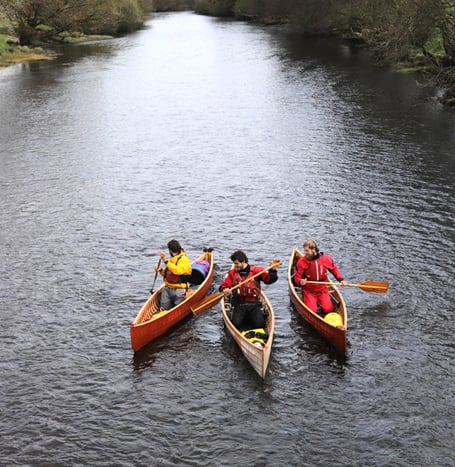
Following on from the success of their 2025 Wye expedition, a conservation education Community Interest Company, Wild Rivers, will be launching their canoes at Glasbury and heading to Tintern on September 14 as part of a two week paddling expedition to connect primary school children with natural heritage and conservation.
Last year, Wild Rivers put together a small team to paddle 135 km from Glasbury to Monmouth in hand-built canoes to promote awareness of the health of the river, and collect data for the community-led conservation Friends of the River Wye.
En route they collected data and information on erosion, areas of pollution, and locations and status of water crowfoot, an ecologically important species which oxygenates water, provides refuge for juvenile fish, and is known to be a water quality indicator.
Expecting a polluted river devoid of wildlife, they were pleasantly surprised by the sheer beauty of the watershed and the wildlife sightings!
Despite high pollution, the River Wye remains a biodiversity hotspot. They saw a number of species including kingfishers, bank swallows, brown trout and a possible sighting of a leaping salmon! Regular sightings of buzzards screeching through the air as well as a couple of breeding pairs of ospreys show that there are apex avian predators still using the rivers' food source.
A few other notable observations en route were the high numbers of willow ermine moth caterpillars, cocooned in a silken webs that covered many of the willow trees. Why such an abundance has occurred locally in the last few years is yet to be understood, though theories point at climate change or a lack of predators.
They regularly saw the UK’s rarest mayfly, the yellow mayfly, similar to the common mayfly seen along waterways but bright yellow, a species which is thought to now only occur in the Rivers Wye and Teme. Despite the Wye still holding a diversity of native wildlife, the level of pollution now apparent due to high levels of agriculture runoff (mainly chicken farms) has caused the rapid decline in many key species.
In many sections they saw evidence of the high levels of nutrient runoff in the form of large algal blooms. Additionally, two outflows smelling of soupy bleach bubbled into the river near Hereford from near the industrial estate, a devastating sight to witness into such a beautiful watershed.
The team will be paddling from Glasbury to Tintern in hand made skin-on-frame canoes, stopping at local primary schools en route to deliver interactive sessions on river ecology, land use and conservation practices.
If you are a teacher or parent at a primary school in the Wye Valley and would like to host a workshop, Wild Rivers would love to hear from you!


The team are also seeking to collaborate with local outdoor companies and are seeking auxiliary equipment for the expedition, including barrels, dry bags, PDFs and paddles.
Please feel free to reach out to [email protected] or visit their website
www.wildrivers.co.uk to find out more or support the expedition
Comments
We've recently changed our login process. If you have an account for commenting, you will need to re-register on the login window.
This article has no comments yet. Be the first to leave a comment.