
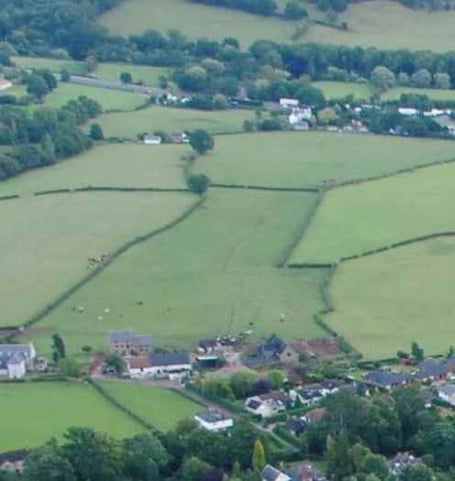
The hearings into controversial proposals for 270 homes at Leasbrook, off Dixton Road in Monmouth, have now ended. The Planning Inspectors must now consider the evidence before deciding whether the site should remain in Monmouthshire’s Replacement Local Development Plan.
The final hearing was dominated by concerns over flooding, landscape impact, protected bats, infrastructure and the speed at which the developer is progressing the scheme.
One of the most striking exchanges during hearings into controversial proposals for 270 homes at Leasbrook, off Dixton Road, was when the Inspectors asked whether all 270 homes could realistically be built before the end of the Replacement Local Development Plan (RDLP) period in 2033.
Craig O’Connor, Monmouthshire County Council’s Chief Officer for Place and Community Well-being, said the developer had “front-loaded” the process and was “in the process of submitting a planning application”.
That raised questions over assurances previously given by the council as at a Place Scrutiny Committee meeting in September 2025. When councillors asked what would happen if a developer submitted an outline planning application, Mr O’Connor replied: “We will not be able to approve any planning applications until the RLDP is adopted.”
Osbaston County Councillor Jane Lucas showed concern after the hearing this week saying: “This front-loading comment is very alarming. We are concerned that the developer will submit an outline planning application before the Inspectors have finished their assessment of the report.”
With flooding in mind, inspectors examined the lower part of the site and its access from Dixton Road, which lies within an area at risk of flooding and has flooded on a number of occasions.
Modelling discussed at the hearing showed that in an extreme one-in-1,000-year flood event, water depths in the lower part of the site could reach around 2.5 metres.
During the discussion, a council flooding officer suggested that one possible solution could be to raise the level of the access road by as much as 2.5 metres.
Further concern arose when it was confirmed that the proposed alternative flood access leading towards Priory Lane and Hereford Road would be for emergency vehicles only. This means the houses could be effectively cut off to road traffic in the event of a serious flood, making site evacuation dangerous.


-in-Monmouth-with-his-saxophone-to-raise-proceedings-for-Velindre-Cancer-Ce.png?width=209&height=140&crop=209:145,smart&quality=75)

The council also faced sustained questioning over the site’s prominent position in the setting of the Wye Valley National Landscape.
Infrastructure and viability concerns were also raised. One participant asked whether the council’s viability work had allowed for land that may need to be set aside to protect skylarks recorded on the site.
A figure of around £6 million was also raised in relation to potentially substantial improvements to the sewer network in Dixton Road.
Monmouth Mayor Cllr Rob Barrell, representing Monmouth Town Council, criticised the site-selection process and the lack of meaningful community involvement in deciding where the town should grow.
Cllr Lucas claimed that there have been around 4,000 representations made by Monmouthshire’s residents, “all of these have been met with no change required.”
One resident later described the council officers as being like “a bunch of sixth formers who had got caught not doing their homework.”
The decision now rests with the Planning Inspectors, whose report is expected in March 2027.
Comments
We've recently changed our login process. If you have an account for commenting, you will need to re-register on the login window.
This article has no comments yet. Be the first to leave a comment.