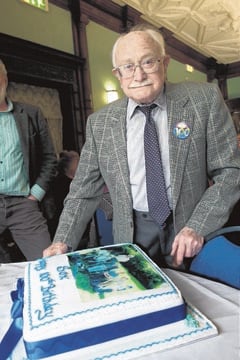
A very special birthday was celebrated last Wednesday (13th March) as Chippenham Court resident Sox turned 100-years-old.
Arthur L Sockett, known as Sox from his time in the military, was surrounded by friends and family at the home on his big day, as all admired a very special birthday card, signed by HM Queen Elizabeth II.
The war veteran and life-long archaeologist claims that the secret to a long life lies with avoiding team sports and concentrating on more 'useful' activities such as cycling and, you guessed it, digging.
Sox has two children, four grandchildren, nine great-grandchildren and a one-year-old great-great-grandchild. Plenty of future archaeologists.



That afternoon the celebrations continued, as an afternoon tea was organised by Monmouth Archaeological Society and the Field and History Society in the Ballroom of Drybridge House.
Sue Miles, chair of the Field and History Society, led the tributes. Sue spoke of Sox's part in founding the society and his time as its one-time president.
Steve Clarke, described by Sox as "one of my biggest achievements" after teaching him at Monmouth School, is now chairman of the Archaeological Society. Steve told the room of Sox's history and of his part in founding and nurturing that society for well over half a century.
The toast was proposed by the internationally-renowned Professor of Archaeology Andrew Fleming, who was taught by Sox at Monmouth School. He spoke amusingly of his time at the school and of the importance of gifted teachers like Sox.
Sox responded with tributes to the two societies and with some of his happy memories of his life and times in Monmouth.
Adding to his other presents and cards, Sox was presented with a cartoon by Geoff Webb (another founder member of Monmouth Archaeological Society) of Sox as a Roman senator.
Sox also paid a visit to his Photographic Interpreter roots to celebrate his 100th birthday with members of Royal Air Force (RAF) Wyton and the Medmenham Collection.
Sox, accompanied by his son Mike and daughter-in-law Melanie, enjoyed a tour of the Pathfinder building, which houses the Defence Geospatial Intelligence Fusion Centre (DGIFC); as well a meeting with current photographic analysts and Director DGIFC, Group Captain Thornber.
His visit culminated with a presentation from the Medmenham collection in Wyton Officers' mess.
Sox received a recent photo of Dransfield House, where he worked during the Second World War, a birthday card from Elizabeth Hick, the last remaining member of N section, with an Alfie Fripp cartoon on the front and a birthday cake.
Mike said: "It's been a great way to finish my father's birthday celebrations here at Wyton, he's definitely enjoying himself and will certainly be tired later on."
Group Captain Thornber said: "Hopefully seeing the Medmenham Collection held at Wyton and meeting the personnel from DGIFC will reassure Sox that the station continues to emphasise the importance of it's heritage".
Flight Lieutenant Collette Parkin, the Commander Joint Force Intelligence Group's Coord, added: "It was a real pleasure to meet Sox, he certainly had some fascinating stories".
Born in Shropshire in 1913, Sox attended Oxford University on an open scholarship where he studied Classics, later gaining a Master of Arts degree where his subject was Ancient Greek. This could have been risky because during the War archaeologists who had studied Greek were being parachuted into Crete to work with the resistance.
Sox joined 7010 Squadran RAF Reserves prior to the Second World War and as a result was called up to RAF Cardington in Bedforshire, where he worked with the airships.
Sox went on to receive RAF training in 1940 as a Photographic Interpreter and specialising in night photography, in the spring of 1942 joined 'N' Section, the Night Photography Section at RAF Medmenham. Interpretation of photographs taken from aircraft while on bombing raids, at night, over enemy territory was an entirely new concept.
Thanks to the pioneering work of the head of section, Bernard Babington Smith, whom Sox greatly admired, it became possible from the plots of bomb bursts, flak, and other lights in the darkness, to determine the accuracy of each aircraft's navigation and positions of bomb release. From these assessments it was increasingly possible to establish the overall success, or failure, of individual raids.
Sox's team, which included several internationally famous archaeologists, were credited with making a major contribution to the Allied Victory for it is said that without that input, the outcome of the war may have been very different.
With the end of the war in Europe, Sox was due to be posted to India, but the dropping of the Atom Bomb in August 1945 ending the war meant he returned to teaching. He was later recalled as a reservist and served with the Unit at RAF Nuneham Courtney. One of his tasks was to measure the speed of London traffic; where Sox discovered that the fastest traffic on the road was a horse-drawn milk float.
Sox came to Monmouth in the 1950s and began teaching as a Classics Master at Monmouth School. At last able to get back to the true love of his life, archaeology.
After the War Sox worked for the second time with Kathleen Kenyon – the famous historian who discovered Ancient Jericho. Sox finished the Headmaster Cunicliffe's excavations of the Gaer on the Great Doward before turning his attention to the town.
Sox claims to have put Monmouth historian Steve Clark into his first trench – a fact undisputed by the latter: "It was on an early summer evening in 1956 that Sox launched the St James' House orchard-garden dig for the Monmouth and District Field Club and Antiquarian Society (now the Field and History Society).
"Several of us schoolboys were allowed to take part after being taught and introduced to him by Keith Kissack. We have many happy memories of that inspirational excavation which revealed the waste heap of an early post-medieval pottery kiln behind the Town Wall."
Despite Sox and his team's many discoveries from various digs around the town, many artifacts remain in storage at the museum due to a lack of display space.
Sox retired from teaching in 1978 and lived at his house in Osbaston for eight years after the loss of his wife, Daphne in 1985.
With thanks to Steve Clark and RAF Wyton
Comments
This article has no comments yet. Be the first to leave a comment.