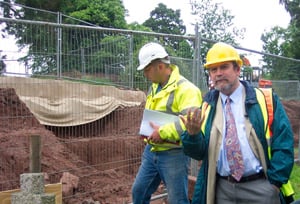
In Roman times, a high tower might have dominated the famous Ross view. Archaeologists are very excited about finds unearthed at the Prospect, which have come to light because of repairs to the churchyard wall. The War Memorial was removed from the corner of the Prospect to facilitate repairs and planning regulations decree that every development has to have an archaeological dig. Dr Keith Ray the Herefordshire Archaeologist, speaking at the site on Tuesday, told the Gazette: "We are fairly sure that the find is Roman. The pottery appears to be Roman. Our main difference of opinion is as to what it is, perhaps a Pharos style tower or beacon, or a mausoleum." He explained that the area had been covered with polythene to protect the finds. "If we walked over it we would destroy it. It is a baked earth circle with a posthole in the middle and it has square foundations at the corners more than one metre thick - quite large stones and that suggests that it was once quite a tall structure." He said that the dimensions were the same as that of the fake Gazebo Tower near the Royal Hotel. "The structures could be of a similar height." He continued: "Nothing has been lifted out, there was a layer of medieval material over the top, and because of the Bishop's Palace you would expect to find medieval remains." Archaeologist, Neil Shurety, explained that they made a number of ditches working right down through Victorian to Medieval and then to Roman. As they were undercutting they were taking samples. He said they found a horses head with a band on it, he added: "The Romans were know for burials of horses' heads and these were not found everywhere. Everything we find is being recorded. There seems to have been an amazing amount of activity in a relatively small area." Councillor Phil Cutter asked if there was any relevance in the main structure being at a high level overlooking the river. Mr Shurety said it was probable that the site had been chosen for that reason. "There was evidence of Roman stone in the base of the churchyard wall which would have been utilised when the wall was built in the 1700s." Councillor John Jarvis explained that the site fell under the the remit of three different cabinet members, Councillor Jarvis himself, Councillor Adrian Blackshaw, who is charge of regeneration and tourism, and Councillor Harry Bramer, resources. He said: "We all recognise that this could be a super site for Ross. We and the local members will have to step back and re-evaluate and all take a look at where we go from here. Clearly the investigation here is going to take time, however that creates a problem locally, the War Memorial was here and by November we will have to find a temporary site for it." Dr Ray said it was important not to get too excited about the finds at this stage. "We have to determine whether it is Roman, and date it to see if it is as significant as we think it might be." He explained that finds have to be sent away for investigation, and they don't come back for a long time. He added: "It is not just important as an individual find but for what it is telling us about the Roman period and the importance of the Herefordshire area in itself."