

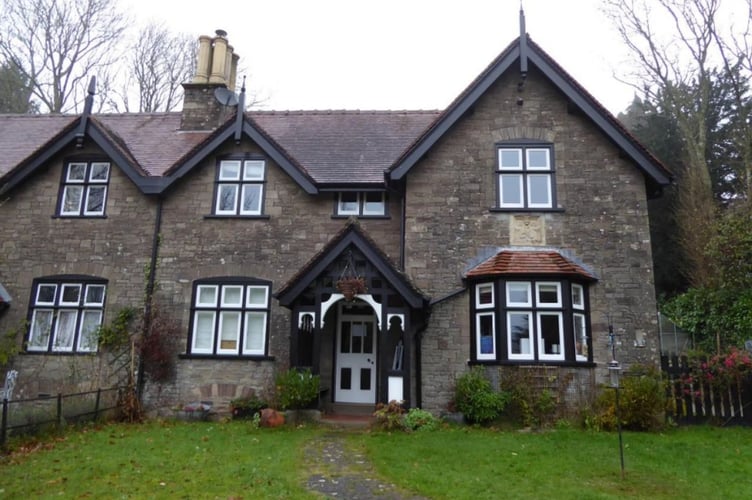
A HOMEOWNER planned a modern extension to her listed cottage built by the estate of the Rolls Royce family after it failed to sell.
Caitlin Williams wanted to extend an existing projection at the back her the two-storey semi-detached home opposite the entrance to the Hendre, a grade II star-listed building which is now The Rolls of Monmouth Golf Club.
The Hendre has been the country seat of the Rolls family since 1767, and was the family home of Charles Stewart Rolls, who co-founded the Rolls-Royce motor company after meeting Frederick Royce in 1904.
The cottage and the Old Post Office next door are grade II-listed as “a well-detailed pair of estate cottages” and part of an “important series of buildings” built by the Hendre Estate in the 1890s and for their group value with the nearby horse trough and Box Bush Lodge opposite.


Monmouthshire County Council’s planning department refused planning permission for the new extension, and listed building consent, in February 2025 due to an unacceptable impact on the building and the character and appearance of the Hendre Conservation Area.
Welsh historic buildings body Cadw had also objected to the application.
Ms Williams appealed to Planning and Environment Decisions but independent inspector Hywel Wyn Jones upheld the council’s decision despite acknowledging “an overtly modern approach to enlarging a historical building is not necessarily harmful”.
Mr Jones said the “contrasting appearance” of additions “can ensure that the original form of the building can continue to be appreciated” but said he agreed with concerns over “the interface between the host dwelling and the extensions”.
He said there would be a “discordant” change in materials, between modern and the traditional stone, and a glazed roof over part of the original building “reinforces a complex appearance where the modern would visually intrude on to the host building”.
He also found the extension would be “a prominent feature when viewing the building from several directions”.
Mr Jones also dismissed Ms Williams’ argument the extension would help keep the building in use as a residential dwelling and stated: “I note the limitations in the present level of accommodation when measured against the household’s expectations.
“However, whilst noting the feedback the appellant received during an unsuccessful effort to sell the property, I am not persuaded that these limitations bring into question the future use of the property as a dwelling.”
As a result Mr Jones said he gave “limited weight to the personal circumstances of the resident family” as it might be possible to adapt or extend the building “in an acceptable manner”.
For more information about planning applications in your area visit https://publicnoticeportal.uk
Comments
We've recently changed our login process. If you have an account for commenting, you will need to re-register on the login window.
This article has no comments yet. Be the first to leave a comment.