

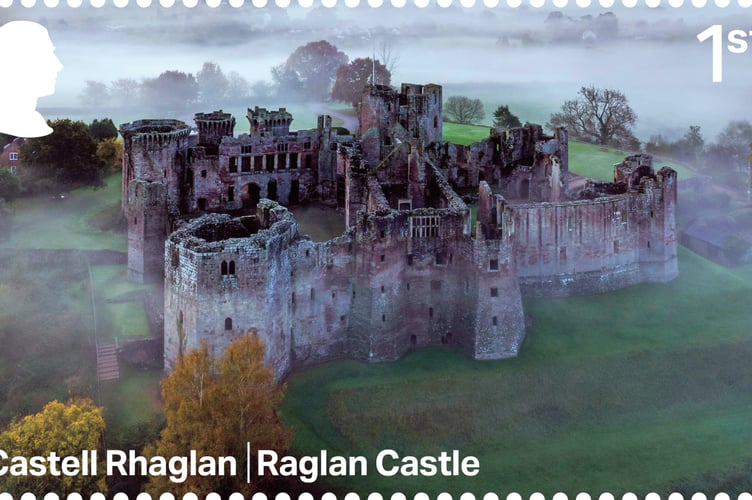
A castle that came to prominence during the English Civil War is to be featured on a set of Royal Mail stamps.
Raglan Castle is one of 12 castles that will be used to showcase the architectural brilliance of castles across the UK.
The main set of stamps features photography of eight castles, from all four nations of the UK, dating from the Norman period onwards whilst a further four presented in a miniature sheet are newly commissioned artworks by British illustrator Rob Ball.
Castles were first built in England in the middle of the 11th century, and from 1066 in vastly larger numbers at places such as Warwick and Windsor, helping to secure Norman rule. With the expansion of Anglo-Norman power, they spread throughout the British Isles, as at Pembroke and Dundrum. The Welsh leaders built their own castles to defend their lands. Castle-building continued throughout the Middle Ages at Caernarfon and far beyond, such as at Dunluce. Many castles occupied prominent and ancient sites, including at Dover, Stirling, Bamburgh and Urquhart.


The greatest castles were developed as prized residences into the 17th century, but many, including Raglan, fell victim to the Civil Wars of the 1640s.
A royalist stronghold during the Civil Wars, Raglan Castle was deliberately destroyed after its surrender on 19 August 1646. William ap Thomas began building the castle around 1435, but it was his son, William Herbert - nicknamed the 'masterlock' or effective regent of Wales - who made it a palace-fortress. The centrepiece was a tower of prodigious size that was known by the 17th century as the Yellow Tower of Gwent. In the 1580s, William Somerset, 3rd Earl of Worcester, further enlarged the castle and created extensive gardens around it.
The other Welsh castle in the collection is pembroke castle. The Normans were quick to extend their power into south Wales in the late 11th century, staking out their conquests with castles. Of these, Pembroke Castle, which commands a natural anchorage, was one of the largest and most important. The great drum-shaped keep that towers over the walls was probably begun in 1199 by William Marshal. He was one of the most celebrated knights of his age and was created Earl of Pembroke that year. The keep was originally crowned with a triple ring of battlements, a very unusual detail.
Today, castles remain an important part of our landscape and heritage, and their extraordinary, varied history makes them fascinating places to learn about and visit.
David Gold, Director of External Affairs & Policy, Royal Mail, said: “This stamp issue celebrates the skill, ambition and design, as well as the durability, behind these remarkable structures from across the nations.”
The stamps, and a range of collectible products, are available to pre-order at www.royalmail.com/castles and by telephone on 03457 641 641. A Presentation Pack including all 12 stamps is priced at £22.50. The stamps go on general sale from 21 May
Comments
We've recently changed our login process. If you have an account for commenting, you will need to re-register on the login window.
This article has no comments yet. Be the first to leave a comment.