

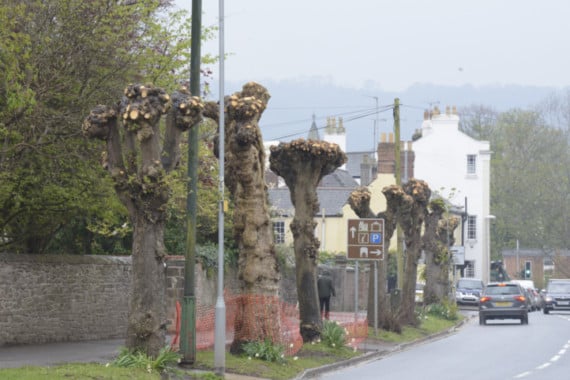
Pollarding of a row of trees on the approach to Monmouth town centre has had some local residents up in arms.
They say the avenue of trees in The Parade - a mix of horsechestnut, lime and London plane - give visitors their first impression of Monmouth but they fear severe pruning in spring, with the leaves just coming out and the trees in bud could kill them.
Mrs Jeana Hall, a former mayor of the town, says she was horrified to see the trees ’cut back to stumps’.
"I’ve done a course with the Forestry Commission and this is the wrong time to be pollarding when the birds are nesting and the buds starting to open," she said. She said she and her husband had counted 11 men and four vehicles at the site on Tuesday and wondered how much the job was costing.


Martin and Diana Russell also fear that pollarding at this time of year could kill the trees.
"I called the county council’ s highways department on Monday morning but, after waiting 20 minutes to get through, my call was forwarded to an answer phone in the complaints department," said Diana.
"With the controversy over the council’s proposals to site a crossing on the road just above the junction with the school, it makes you wonder if killing off the trees could be part of the plan?"
A tree expert told the Beacon: "Existing arboricultural advice recommends trees should not be pruned in spring as the leaves are forming or in early autumn as the leaves are dropping. Also, the pollards must be cut above the previous cuts not below them. Ignoring this advice may impact on tree health."
An MCC spokesman said pollarding - an ancient form of tree management - can prolong the life of trees and was used on internationally important sites like the New Forest and Epping Forest.
"The trees on The Parade have been pollarded by an experienced arborist within our grounds team carrying out work for our highways service," he said. "We urge people to be patient and see how the trees respond. These trees are mature but not excessively old and, as they have a history of pollarding, they should be resilient. Importantly, once a tree has been pollarded a few times, the practice needs to be continued."
He added that pollarding of street trees is common throughout Europe and something carried out on a number of trees on Monmouthshire’s streets - in cycles of anything from two to 15 years. It allowed species that would ordinarily be too big to be retained in a small space.
Comments
This article has no comments yet. Be the first to leave a comment.