

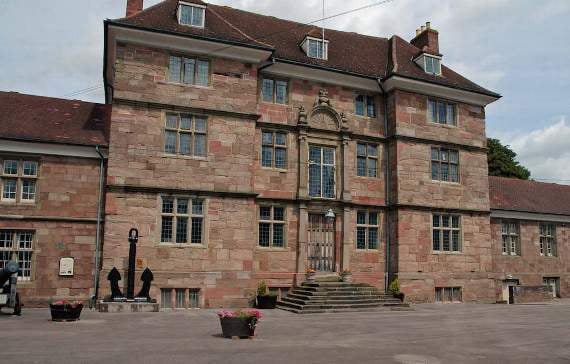
SOME of the most interesting properties in Monmouthshire will be welcoming visitors on 8th and 9th September as part of national Open Doors weekend.
The aim of Open Doors is to give people an opportunity to discover new locations and rarely seen history, by offering access to sites usually not open to the public.
The event was not staged in the town last year after a slight fall in visitor numbers in 2016, but organisers Monmouth Civic Society are hoping that this year will attract a good turnout, with 18 properties involved.
Taking part for the first time will be The Malthouse in St Mary Street, which is currently undergoing restoration. It contains probably the most complete malting floor in Wales with a Welsh patent furnace of 1864.




Also involved is The Priory in Priory Street, the town’s one remaining monastic building following the Dissolution of the Monasteries under Henry VIII.
Now a parish community centre, the building’s best feature is a fine 15th-century oriel window supported by carved corbels depicting the powers in the town - the knight (law), the church and the miller (trade). It is called Geoffrey’s Window, after Geoffrey of Monmouth, who created the legend of King Arthur – hundreds of years before the window was made.
The Open Doors event takes place across Wales under the umbrella of Cadw, the Welsh historic monuments body, and numerous properties near Monmouth are included.
Well worth a visit are the two small Georgian buildings on The Kymin: the circular two-storey dining club and the unique Naval temple celebrating the victories of the Royal Navy during the Napoleonic wars.
As a bonus, on Sunday 9th September, one of the talented and experienced volunteers will help and encourage anyone to have a go at painting their own watercolour picture there – with all materials provided free of charge.
Back in Monmouth, Great Castle House and the Regimental Museum will also be open to the public.
The house dates from 1673, built with plenty of swagger by the future first Duke of Beaufort, using stone from bits of the castle demolished after the Civic War.
The first floor plaster ceiling is not to be missed. This room was once used for trials but is now the headquarters of the Royal Monmouthshire Royal Engineers (Militia), the senior regiment in the British Army.
Meanwhile, in the Usk area, visitors will be able to explore the redundant church of St David’s at Llangeview, largely built in the 15th century and now in the care of the Friends of Friendless Churches; St Jerome’s Church at Llangwm Uchaf, renowned for its late 15th century screen and St Mary the Virgin Church, Llanfair Kilgeddin - a Grade I listed medieval church which was rebuilt in the 1800s carefully re-using some of the earlier fabric.
Comments
This article has no comments yet. Be the first to leave a comment.