
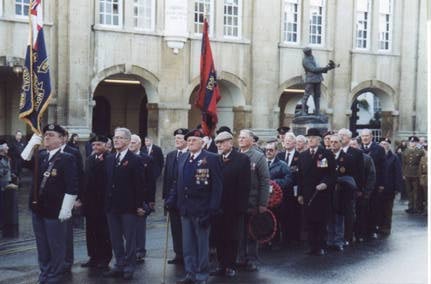
MONMOUTH remembered its dead with two minutes silence on Saturday and Sunday.
On Saturday a rocket was launched at The Castle to mark the silence.
On Sunday the annual Royal British Legion Remembrance Sunday Service was held at The Cenotaph.
Lessons and prayers were said and the Last Post sounded before the silence. This was followed by the Royal British Legion Exhortation and Kohima Exhortation, Reveille and the laying of wreaths.


People of all ages gathered for the service, from the young to veterans of the conflicts.
Among those laying wreaths were the County Council, Mayor Cllr Richard Bond, MP Huw Edwards, Royal British Legion, HMS Monmouth, the CO of the Royal Monmouthshire Royal Engineers (Militia), RE Cadets, Royal Naval Association, Royal Engineers Association, Parachute Regiment Association, Royal British Legion Club, St John Ambulance, Monmouth Police, Monmouth Fire Brigade, British Red Cross Society, Monmouth Rotary Club, Monmouth Lions, Monmouth School, Scouts Association, Guides Association and the Brownies.
The service at the Cenotaph in St James's Square was followed by a service of remembrance at St Mary's Church and a wreath laying ceremony at the War Memorial of the Royal Monmouthshire Royal Engineers (Militia) in Castle Square.
In his sermon, Mr Matthew Christmas, a TA officer and Officer in Monmouth School's Combined Cadet Force, spoke of the sacrifice made by many.
He said there was always the dreadful possibility that one of the cadets encouraged by the CCF to join the forces would lose his life in that service.
"This came home painfully, just over 18 months ago, when one of our recent Old Monmothians, Gareth Evans, a Royal Engineers Officer attached to the Gurkhas and formerly the senior cadet in the Combined Cadet Force, was killed in Kosovo with one of his men trying to make a school safe from unexploded bombs. He was only 25 years of age."
In his other role as History teacher at the School, Mr Christmas said part of his job was devoted to the study of the two World Wars.
It was hard not to be caught up in the emotions of the First World War in particular when so many young men were killed with often no hope of their military objectives being achieved.
Two old boys of the School were killed on the first day of the Battle of the Somme, Henry Rees of the Monmouthshire Regiment and Andrew Weatherhead of the King's Own royal Lancaster Regiment. Two others died two days later and another seven died before the battle was finally ended.
The effects of war were seen at the hundreds of tiny cemeteries dotted all over Picardy and Flanders.
A total of 76 Old Monmothians died in the First World War and research has begun into their lives in the hope of publishing a Book of Remembrance which makes them more than just names on a wall or memorial.
The same experience applied equally to other schools to Monmouth as a town and to all other regiments and branches of the service.
"Above all remembrance must be about the effect of war on people as individuals, but also as part of communities," he said.
It was important that those who served and lived through those times told the younger generation what had happened to them. The young wanted to know and learn from those who had lived through the conflicts.
Respect and remembrance was not about a parade once a year or the wearing of a poppy. It was about the honest realisation that the dead and the survivors wanted an uncluttered life and the chance to make their own destiny without the scars of conflict which never truly heal, he said.
It was about ensuring that those who fought were able to live with the dignity which they had truly earned.
Society was gradually beginning to recognise that war not only affected those who fought.
"In remembrance we should not triumph nor condemn, but learn, remember and try to understand. Only then do we have some chance of avoiding such wars in the future," he said.