
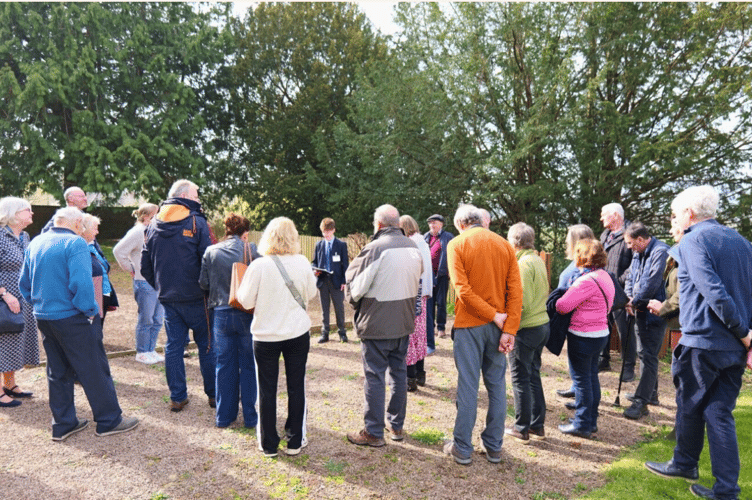
CHAPEL House located on Hereford Road in Monmouth opened its doors to the Monmouth community during its Heritage Days taking in the history of the building shortly before it goes up for sale.
The tours which took place over the course of the two days gave people an opportunity to learn more about the buildings history. The house was known over three centuries as The Elms, The Chantry, St Bride’s and most recently as a boarding house.
On the days visitors were welcomed with tea, coffee and home-made cakes. Head of Haberdashers’ Monmouth School Melvyn Roffe began the event with an opening of sharing the excitement about the life of the house and a moment of realisation it would be the last time the school would host the school’s community before it goes up for sale.
The tours were led by school pupils – The History Hunters who gathered research about the history which is held in the house and how it has evolved overtime.


The tour started in the Entrance Hall where pupil Seb introduced the visitors to the long evolution of the house, saying how the buildings origins might date back to around 1720, a time when ironmaster William Rea, spurred on by high iron prices who had likely built an impressive home to reflect on his own success. This prosperity was shortly lived as the fall in iron prices saw Rea financially ruined.
Rea’s successors, David Tanner who was another ironmaster also met misfortune. Tanner supplied cannons to the British Army during the American War of Independence, but their poor quality contributed to his bankruptcy.
The group highlighted the core details of the building, including the symmetrical windows, sash frames and the classical pedimented doorway with pilasters and a fanlight which was believed to have been added during David Tanner’s alterations in the 18th century.
The building was renamed as St Bride’s after the patron of hospitality, and St Bride’s Day each February was marked with a green-iced cake.
Back inside the building Seb led the visitors to the fireplace which and the name “Humphrey Farran Hall” carved onto the fireplace alongside the date 1910. Seb explained that although the panels appeared Georgian they were actually Edwardian.
The tour made its way to the cellar when former boarder Max shared how he used to board in Chapel House. Although the rooms were used for Monmouth School for Boys in their most recent history they were also originally used as the domain for servants.
The history tour led to other areas of the house, each uncovering more history where Tasker and Nye guided the visitors through Chapel House’s listed garden who said that there are fewer then 400 gardens in Wales who hold this listed status.
The students shared a true story of Ronald “Scarface” Mauri who was a fugitive murderer who fled London in 1945 and ended up hiding in this garden. “Scarface” Mauri.
Throughout the event there were also archive displays shared where people often recalled memories of apple-picking, home-baked puddings, cricket and croquet.
Comments
We've recently changed our login process. If you have an account for commenting, you will need to re-register on the login window.
This article has no comments yet. Be the first to leave a comment.