
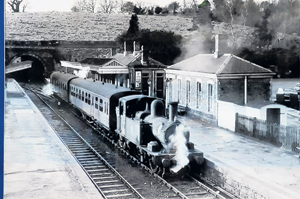
THURSDAY, 19th October, 1876, was a date eagerly awaited by some but dreaded by others, for that was the day marked as the official opening of the Wye Valley line.
This new railway was expected to revitalise the industrial and commercial life of the Lower Wye Valley and to improve the lot of the travelling public.
However, many viewed such progress with trepidation – would the noise and disturbance of the station engines frighten their farm animals, causing hens to stop laying and cows to go dry?
Now, more than a century later, the age of steam has come and gone, and farm animals apparently suffered no ill effects.




The opening day was a grand affair; in attendance were the Directors and Engineers of the Wye Valley Railway Company, officials of the Great Western Railway Company and several local dignitaries.
According to the report in the illustrated London News for Saturday 28th October 1876, everything went according to plan.
Scheduled services on the 13-mile single track Wye Valley Line commenced on Wednesday 1st November 1876.
The cost of constructing the line came to £318,000 (about £16m at today's prices) and took some 30 months to complete. Most of the expenditure was incurred on the 4-mile section between Tintern and Tidenham where very hard limestone rock was encountered. The most difficult work took place here, with the boring of Tidenham tunnel. This took 19 months (with men working on it night and day) and was grossly underestimated both in cost and length, being 1188 yards long when completed compared with the original estimate of 715 yards.
Newspapers of the time reported that according to the local clergy the conduct of the men (navvies) employed on the construction of the line had been 'most exemplary'.
Great things were expected of the Wye Valley Line.
The Monmouthshire Beacon newspaper of 21st October 1876 said, "whilst opening up a new district hitherto unapproached by railway traffic, the new line will prove a great convenience not only to the locality through which it runs, but to the travelling public at large..."
"The gradients and curves of the line are good, the line having been constructed with the idea of accommodating the through traffic from Bristol to the North of England..."
For more on this story, see The Monmouthshire Beacon issue dated January 7th 2009.
Comments
This article has no comments yet. Be the first to leave a comment.