
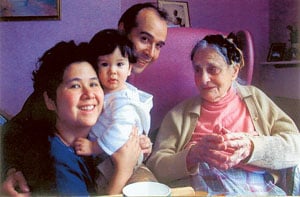
When friends and relatives gathered at Marsden House, Whitchurch, on Wednesday, to celebrate the 100th birthday of Mary Thomas, they were raising their glasses to a very remarkable lady. Not only has Miss Thomas achieved the distinction of living to a ripe old age, she is also remarkable for being one of the longest living survivors of internment by the Japanese after the fall of Singapore. Most of her internment was spent in Changi Gaol, where over 4,000 men, women and children were held captive, enduring a harsh regime under the Kempatai, the Japanese Military Police. Mary recorded her indelible experiences in a book entitled "In the Shadow of the Rising Sun," which was published in Singapore in 1983. However, even before this period in Changi, Mary's life had been unusually accomplished and adventurous for a woman born in the early 1900s. The eldest of six children - the other five were all boys - Mary gained an honours degree in history at St Anne's College, Oxford. Afterwards she spent two years on Vancouver Island where she did some teaching, before returning home via the Pacific, spending time in Hong Kong, Ceylon and Bengal, where she had family connections on her mother's side. Her great grandfather was General Sir Henry Montgomery Lawrence, who was killed defending Lucknow during the Indian Mutiny. His younger brother also served in India, and became Lord Lawrence, succeeding Lord Elgin as Viceroy. At the outbreak of World War II Mary had tried to enlist in the British Nursing Service as a volunteer auxiliary but there was a waiting list of over 20,000. An attempt to join the Women's Land Army was also unsuccessful for much the same reason. So at the age of 32, Mary agreed to accompany her brother Francis who was on the point of returning to Singapore, where he was an assistant master at St Andrew's School. They arrived back in December 1939. As time went by and the Japanese invaders drew closer, teaching duties were superseded by voluntary work, leading to Mary becoming Assistant Superintendent at a first aid post established within the school. On December 13th came the news of surrender. This was followed by a period of uncertainty, which came to an end for Mary early in March when she was interned, first in Katong and later in Changi until 1944 when she was transferred to another camp at Sime Road. Like her fellow prisoners, Mary was required to bow low when confronted by a Japanese - for a woman, failure to do so meant a slap in the face. A typical cell for two women measured seven feet long by six and a half feet wide, with a concrete slab in the middle to act as a bed. Food was scanty. On one occasion Mary got into trouble by writing a poem entitled "Changi Lullaby," which included a reference to "the clash of a chain." The Japanese authorities thought this was a reference to fetters. In fact, the chains were lavatory chains which were pulled more or less continuously through the night as a result of the diuretic effects of the prison diets. Instructed to read the poem in a deadpan voice to the Japanese Commandant, Mary escaped with a telling off to confine her remarks to topics not connected with internment. After being released Mary made her way back to England and became a teacher once more. Her youngest brother Christopher, was missing, presumed killed in action in Burma and Francis, having been a prisoner of war in Changi, Thailand and Japan, resumed his teaching duties and later became Minister of Works and Communications in Singapore's first independent government from 1955-1958. Mary is closely connected with the Society of the Sacred Cross, a contemplative Anglican religious order based at Tymawr Convent, near Monmouth, and is a long standing Associate of the community. She lived for many years at Parkhouse, near Trellech, before failing eyesight prompted a move into residential care. With the resilient spirit which had served her so well during her internment, Mary has continued to keep herself abreast of current affairs with the aid of tape recorded versions of "The Times Literary Supplement" and "The Tablet." With the aid of the RNIB Talking Books and through the kindness of friends who read to her regularly, she has been able to continue enjoying good literature.


