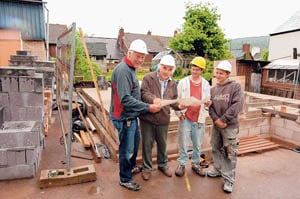
Monmouth Archaeologists have discovered a previously unknown Roman Fort in the town and at the same time have solved a 25-year-old mystery. The latest discovery, described by Monmouth archaeologist Steve Clarke as "one of the most exciting discoveries in south east Wales for many years," has occurred on a building site beside the medieval town wall near Dixton Gate and it has been possible to estimate the probable size and position of the Fort. Members now think that there were two Roman Forts in the town – the earliest one, built around AD50, being very large and extending eastwards from No. 20 Monnow Street. The new one is smaller and later, covering an area bounded by Monk Street, St. James' Square, the Burgage and just to the south of the New Dixton Road. "This precise siting is possible because the latest find covers the south-east corner of the Fort and ties in with a previously unexplained ditch which the Society unearthed in Monk Street a quarter of a century ago," said Mr Clarke. Excavations for the foundations of a bungalow at the Town Wall encountered rather soft ground and when the building inspector expressed concern, a structural engineer was employed and the excavations taken deeper. Archaeologists took over the digging when coins and Roman pottery were unearthed and it became clear that the soil on the north of the plot was the backfill of a ditch which produced only Roman pottery. The sharp angle of the edge of the ditch suggested that it was a military fortification but no corresponding line of a ditch could be found on the opposite side of the site. When a second, similar ditch edge was found on the west of the site and again there was nothing corresponding on the opposite side, it dawned that the two ditches were converging. "They formed a perfect right-angled corner of a Roman Fort," said Mr Clarke. "When the alignment was extended, it pointed directly towards the corner of Monk Street – beside Pitman's Court. "Here, another perfect right angle would lead precisely along the line of a deep ditch discovered in the front gardens of the Royal George in 1982. This was exactly parallel to the ditch projected northwards from the Town Wall. "Crucially, other excavations and roadworks have proved that the Monk Street ditch does not extend as far north as the traffic lights or beyond Whitecross House on the south." There have been excavations behind Whitecross House, St. James' Mews, Pitman's Court and service excavations in the roads; there have also been service excavations into natural ground around the traffic lights and at Lancaster House and all of these have shown that both ends of the ditch must have turned sharply somewhere else – east or west. Mr Clarke said this information was essential when excavations for the footings of a small bungalow began at the Town Wall off St. James' Square and the two converging military-style ditches were revealed. "The Monk Street ditch was found under a medieval road which had been sinking into the ditch since at least the 13th century and although the archaeologists dug down over three metres below the two front gardens the origins of the ditch was not established at that time. "The lower fill of the ditch, although still containing medieval pottery also produced a Roman coin of the Emperor Gallienus dated AD 260-268. The distance from the Town Wall fort corner to the Pitman's Court corner – some 120 metres – together with the known limits of the Monk Street ditch form the classic playing card shape of a small Roman Auxiliary Fort." he added. The Society's 1982 excavations in the gardens of the Royal George Hotel (as it was then) were carried out together with teachers and pupils from Manchester Grammar School. The dig at first revealed the road shown on John Speed's map of Monmouth in 1610; this road was abandoned in the 18th century – around the time that the Royal George was built – and was covered with natural red clay, probably from the digging of cellars. However, the ground over the ditch continued to sink, as it still does today, causing damage to the roadside walls. "The ditch was not the medieval Priory precinct ditch which surrounded parts of St. Mary's Churchyard – that was also shown on Speed's map – still open with bridges and a gatehouse and must now lie partly under the western side of modern Monk Street," Mr Clarke said. "In fact, the Royal George ditch seemed unlikely to be medieval at all, for most of the town defences of that period were well known. "An 'Auxiliary' Fort such as this, with earth and timber defences, may have housed up to five hundred Roman soldiers, whereas the large 'Vexilation' Fort, envisaged in Monmouth would have been the base for about two thousand troops during the first and unsuccessful invasion of southern Wales. "This was in the middle of the First Century AD and it was at this time that the Romans also built a Fortress at Usk, housing some five or six thousand soldiers – a quarter of a century before the stone Fortress at Caerleon was established. "The Romans suffered very heavy casualties and in the ensuing guerrilla war, the early Welsh held out against the invaders for thirty years. "The newly discovered Roman Fort was probably built in the later 1st or early 2nd century and may still have been occupied alongside the industrial town of 'Blestium' which is recorded in a Roman 'road book' of the 3rd century." The discovery of the new Fort had greatly increased the archaeological importance and potential of this area of the town, said Mr Clarke.