

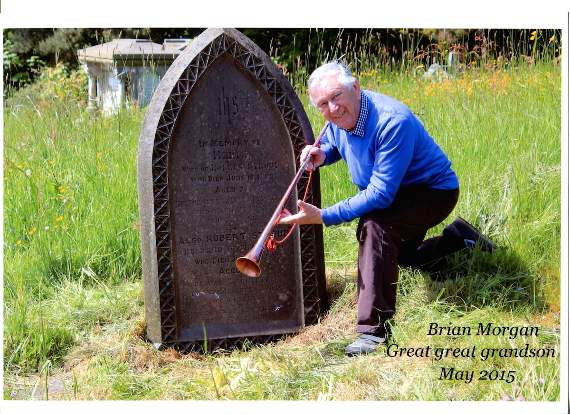
A descendenT of a much respected trumpeter to Her Majesty’s Judges has restored his great, great grandfather’s grave.
Chartism was the first working class movement in Britain directed at reforming Britain’s Parliamentary democracy, reaching its height in the 1830s and 1840s. During the trials, Robert Stroud was in charge of the prisoners’ welfare when they were in the holding cells beneath the Shire Hall.
After a life dedicated to his work, Robert passed away in 1898 at the age of 93, and was buried at Monmouth cemetery, with his grave now a part of the Monmouth Chartist trail.


And now, his great, great grandson Brian Morgan has succeeded in restoring the print on the grave, which due to its age was almost unreadable. Brian was able to restore the lettering on the grave without moving or altering the grave in any way.
“I got the work done not only on behalf of the family but also to keep his (Robert’s) story alive for Monmouth Town Trail.
“The whole process only took about four hours. One of our neighbours who’s a stonemason came down to the grave and cleaned the lettering with a scrubbing brush. I treated it with some chemicals to preserve the stone, and that was it.”
In addition to the restoration of the grave, Brian has also found the announcement trumpet, the same of which was played by Robert over 150 years ago.
Robert’s grave can be found in Monmouth cemetery, plot D-92. The Chartists trail explores many of the old town buildings and locations with connections to the Chartists. More information can be found with Friends of Monmouth cemetery.
Comments
This article has no comments yet. Be the first to leave a comment.