

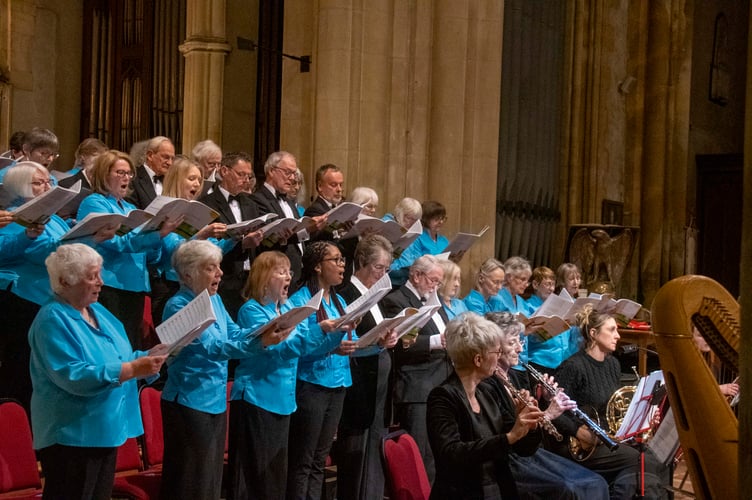
THE recent performance of Elgar’s oratorio Dream of Gerontius by both Monmouth and Chepstow Choral Societies was a complete sellout. From the first notes of ‘Gerontius’ followed by those of the semi-chorus in the sensitive acoustics of the Blake Theatre, it was evident that this performance was going to be a winner.
This dramatic work to which many choral singers aspire depicts spirituality, steering away from biblical text in favour of a poem by Cardinal John Henry Newman. In addition, Elgar uses the orchestra’s role following Wagnerian style, to portray the narrative with equal status to the singers.
By combining forces with Chepstow Choral Society and a semi-chorus from Bristol and with the added bonus of generous sponsorship, Monmouth Choral Society was able to effect a nostalgic occasion, performing with the Regency Sinfonia, an orchestra of professional musicians with whom Monmouth once had a longstanding and regular relationship.
An array of excellent soloists complemented the event.


Andrew Henley’s delivery of the demanding part for tenor soloist (Gerontius/Soul) was constant throughout with clear enunciation gripping the audience’s attention. Alex Jones’s rich bass voice gave a commanding portrayal of the Priest contrasting with tender yet dramatic tones when representing the Angel of Agony and Susan Marrs (mezzo-soprano) representing the Guardian Angel gave a particularly versatile rendering of Elgar’s evocative music.
The performance was conducted by Steven Kings, Monmouth Choral Society’s Musical Director. Elgar scored for 2 choruses so while Monmouth was rehearsing on home ground, Chepstow Choral Society could rehearse on theirs with Musical Director
Graham Bull. It was clear that both choirs had practised with sincere attentiveness to ensure their mutual compatibility when together.
Singing, now recognized as a significant contributor to both physical and mental well-being has led to choirs mushrooming throughout the country spanning a variety of musical genres. Consequently it was inevitable that choral societies in rural areas, particularly after the pandemic, would experience some decline in numbers that would also restrict them financially in funding larger choral works with professional orchestras.
The initiative of two like-minded choral societies coming together in the Blake theatre, where acoustics facilitate the blending of vocal sounds, has indeed contributed to the success of this performance. Determination that ‘the show must go on’ despite adversity caused by Monmouth’s recent flood disaster was indicative of everyone’s commitment. Perhaps this combined performance, cheered and applauded by an enthusiastic audience, will give rise to future similar occasions and encourage others to sponsor and participate in such exciting and exhilarating ventures to delight more audiences in the future.
Chepstow Choral Society was formed in 1979, and has been performing live music in the town regularly ever since. Currently directed by Graham Bull, Head of Performing Arts at a leading Gloucestershire school, it has about 65 members in total, of all ages & abilities.
Monmouth Choral Society has been making music for 150 years. They aim to bring local choral singers together with professional soloists, accompanists and orchestras, to learn and perform great choral music.
Comments
We've recently changed our login process. If you have an account for commenting, you will need to re-register on the login window.
This article has no comments yet. Be the first to leave a comment.