
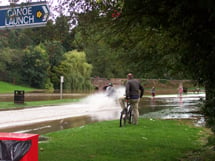
THE DESTRUCTIVE power of flash flooding was shown in dramatic fashion at Lewstone, near Whitchurch, late on Friday September 5th.
At around 11pm, a torrent of water roared down the moderately inclined road between Lewstone Farm and Lewstone Mill, stripping the tarmac from a 250-yard stretch and scouring down as far as the bedrock, in some places to a depth of nearly two feet.
A section of the adjoining bank collapsed, throwing soil, grass and recently planted saplings into the flow of debris, and at the Mill a short distance further on, Susan and Henry Emden saw their garden and ground floor submerged by a brown lake more than three feet deep.
The waters had subsided when the Ross Gazette visited the scene on Saturday afternoon, but they had left spectacular proof of their force. Dozens of chunks of tarmac, many two to three feet across, had been deposited near the bottom of the slope like a pile of pancakes, and around them was a mess of mud, coarse gravel and some very large stones.


Mr and Mrs Emden were starting to clean up, both in robust good spirits despite the extensive damage to their home. As well as the main part of the house, the water had engulfed a newly converted barn, and their son's once immaculate Austin Seven roadster had been swamped well above the axles. A mud slick covered the driveway, and a tide mark on the walls and windows showed how far the flood had risen.
Even after the recent heavy rainfall, Friday's events were unexpected. "The site isn't prone to flooding", said Mr Emden; a concrete culvert on the other side of the road, dug seven years ago, should have channelled the water away from the house. This torrent had been so strong, however, it had washed "an enormous pile of tree roots" down the road, and the culvert had been blocked.
Just as remarkable as the damage to the road and the house was the short lapse of time between the flood's beginning and end. Jim Herbert, who works on the farm at Lewstone and teaches biology at John Kyrle High School, reported hearing a vehicle drive down the road as late as 10pm. The flash flood started not long afterwards; and, said Mr Emden, although the water rose quickly around the Mill, "it had gone back down within an hour."
Mr Emden praised Herefordshire Council for its helpfulness and fast response. Two council employees were sent out early on Saturday morning to clear away some of the mud and vegetation, but the road higher up will remain impassable for some time. The council press office told the Ross Gazette that repairs will start as soon as possible, but the first task is to assess the flood damage across the county as a whole.
Other water-related disruption near Lewstone included a landslip and collapsed road two miles to the west, which prevented vehicle access to Buckholt from two directions, and a second landslip on Little Doward that required a house to be evacuated. Elsewhere in the county, excess water forced more than a dozen roads to close, including the road at Hole-in-the-Wall and the road between Sellack and Hoarwithy.
Nearly twice as much rain fell in the first week of September than fell in the whole of the month last year. 90.8mm of rain fell between September 1st - 7th, and 49.1mm fell in the whole of September last year.
Comments
This article has no comments yet. Be the first to leave a comment.