
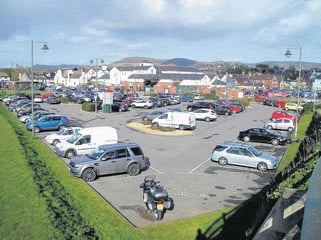
Increase car parking fees, charge Blue Badge holders and scrap free parking on Sundays and evenings.
Those are the recommendations being put before county councillors following a review of car parking in Monmouthshire.
Consultants Parsons Brinckerhoff also suggest upgrading ticket machines, improving signage and introducing a two-hour no-return policy for short-stay car parks.
Monmouthshire County Council's (MCC) economy and development select committee scrutinised the report in a meeting last Thursday (20th February).




Members came out strongly against Sunday and night charging, with Councillor Armand Watts describing the proposals as "an attack on the night-time economy and an attack on the local Christian community."
But the committee disagreed on charging Blue Badge holders to park.
Cllr Bob Hayward said it was "acceptable and justified", pointing out there are 1,087 badge holders in Monmouth in a population of about 9,000, but Cllr Sue White said it was "discrimination".
Roger Hoggins, MCC's head of operations, told councillors Blue Badges were not means-tested, but based solely on people's medical conditions.
"Charging [Blue Badge holders] is commonplace in the private sector," he said, adding that Herefordshire Council also charged holders.
Andrew James, Monmouthshire's disability champion, said the issue for badge holders was not cost but accessibility.
"Blue badge holders can park on double yellow lines. If charges are brought in, more people will park on double yellow lines which I think is dangerous," he said.
The report estimates Sunday parking to be worth £60,000 to the county, with Blue Badge charging predicted to bring in more than £98,000 a year.
It also says parking charges should be increased by a minimum of 20p for each hour tariff to help MCC meet the £9 million gap in its budget.
Mr Hoggins said: "The charging structure has not been reviewed for seven years.
"Every year we set the budget assuming that fees and charges go up by about two per cent, but we have done nothing to effect that change.
"Other things do affect revenue, such as the downturn in retail and changes to shopping patterns."
Committee chairman Cllr John Prosser said members could see the need for increasing fees in some instances, but need more information.
Cllr Sara Jones questioned whether higher charges would increase footfall and wondered if making all car parks free had been considered as an option.
Mr Hoggins said 'going free' would impact the council's budget by £1.3million, but would reduce operating costs.
Cllr Hayward asked why the minimum tariff was for two hours.
"Why not one hour?" he said, "why a one size fits all approach?"
"The towns have different needs – Chepstow and Abergavenny have lots of spaces and need to increase footfall. Monmouth has the opposite problem, there are a lack of spaces and lots of people wanting to visit."
Mr Hoggins said there was a proposal in the report to make the first hour free in the county's car parks.
Cllr David Dovey said Chepstow already had spaces for half an hour's free parking, which work "extremely well, and are pretty much self-monitoring."
Many of the suggestions rely on MCC upgrading its ticket machines, improving signage and better maintaining its car parks.
"The current machines are 17 years old and need updating. The new ones allow you to pay by cash, card or phone but don't give change," said Mr Hoggins, adding: "It is fair to say most car parks are in a poor state of maintenance."
The issue of on-street parking was also raised at the meeting.
Mr Hoggins said in every police authority in Wales other than Gwent, on-street paring offences had been de-criminalised and enforcement handed to the local authority.
The committee said it made sense for the council to take over, and would await discussions with Gwent Police.
The full report can be found at http://www.monmouthshire.gov.uk">www.monmouthshire.gov.uk
Comments
This article has no comments yet. Be the first to leave a comment.