
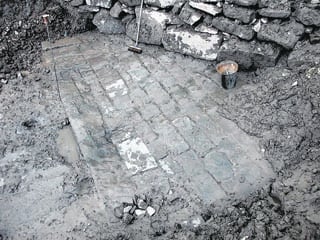
The slipway dates back to Roman times when it was the site of a ford across the river, before Ash Weir upstream was built, apparently by the Abbot of Tintern Abbey, and the river became too deep to cross.
From then on the slipway was used for river traffic coming into the village and travelling on up the Wye to Brockweir and Monmouth.
Parish records and photographs show that trading use of the wharf continued until at least the First World War. Local activities such as logging, fishing and use by boats are still enjoyed to the present day. Horse towing of river barges has been carried out from Fryer's Wharf within living memory.


Members of the Fryer's Wharf and Slipway Restoration Project seek to see the landmark returned to its former glory.
Campaigners want to see the wharf become Tintern's only safe river access, bringing tourism and business to the old part of the village.
The volunteers have faced several hurdles in their journey so far, beginning their first attempt in 1995.
Obstacles include working around a retaining wall for the ancient St Michael's church that runs adjacent to the wharf.
The church outdates Tintern Abbey by around 300 years and the definite age of the wall is undetermined. The group are carrying out a geotech survey to determine the stability of the wall, and have sought permission from the church to investigate the wall around the graveyard.
As well as battling the tides and the mud, the largest obstacle facing the group comes in the form of a 1960s sewage pumping station sitting directly on top of the wharf.
The group intend to convince Welsh Water to move the station from the site, and to put it underground.
It will cost £150- 200,000 to relocate the station, but allowances will be made by the water company because of the proposed improved efficiency of the station.
A sustainable development grant of £10,000 has previously been presented to the group, and a further £6,000 will be given this year. A splash grant was also given to the group but the remaining money must be raised by the volunteers. Help has been provided by Monmouthshire County Council, local canoe groups, Welsh church Fund, Cadw and the Newgrove Trust, but there is still a long way to go.
If you are interested in getting involved with the project, email the Beacon at [email protected]">[email protected]
Comments
This article has no comments yet. Be the first to leave a comment.