Monmouth archaeologists have published details of the New Stone Age hearth, uncovered whilst Charles Church Wales were excavating the attenuation pond on the Parc Glyndwr development off Rockfield Road.
Samples of charcoal from the hearth have been dated to around 2,795 BC.
The survival of Stone Age sites in open countryside is extremely rare as the remains are mostly ephemeral and have usually been ploughed away on farmland or destroyed by tree roots in woodland.
People of this period – the Neolithic – before the age of metals, were just beginning to practice farming and their flint tools and weapons are normally the only evidence of their activities.


The hearth was composed of a circle of stones about half a metre across containing charcoal, cremated bone and two very small flints with another small flint a metre away.
The site lies on the edge of a large prehistoric lake which also attracted Bronze Age settlement including four mounds of 'pot boilers' which were stones burned in a fire and used to boil water. These have revealed a very long period of occupation from the Bronze Age: 1,090BC; 1,680BC; 1,770BC and 1,815BC.
The most enigmatic discovery was that of three shallow linear cuts across the 1,680BC burnt mound which were filled with anaerobic (white) clay. These may have contained the wooden foundations for a structure which has totally rotted away.
This same burnt mound has produced Early Bronze Age pottery while broken Stone Age flints were found in the linear cuts.
The archaeologists say that it is quite remarkable that so much history has been concentrated in an area less than 50 metres long.
The unit is very grateful to the developers for funding the radiocarbon dating from the Scottish Universities Research Centre and for other costs.
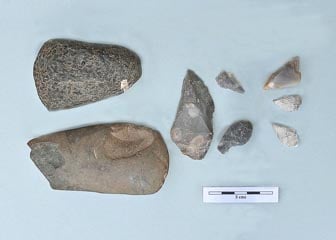
Pictured are New Stone Age tools and weapons from Monmouth. Top left: stone axe made in Cornwall. Bottom left: stone axe made in Great Langdale and found in a medieval house on Newton Court Hill. Right: Neolithic knife and arrowheads from ploughed fields.
Comments
This article has no comments yet. Be the first to leave a comment.